| # | Name, and Location A. | Description/Background/Acquisition Details B. | Photos C. |
|---|---|---|---|
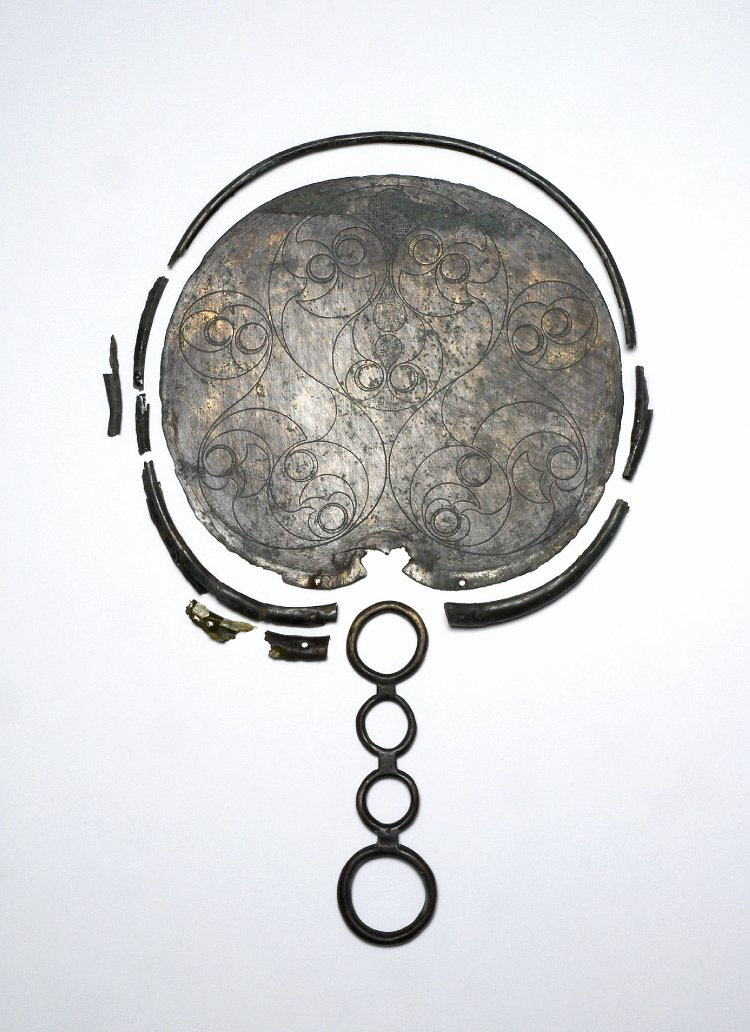
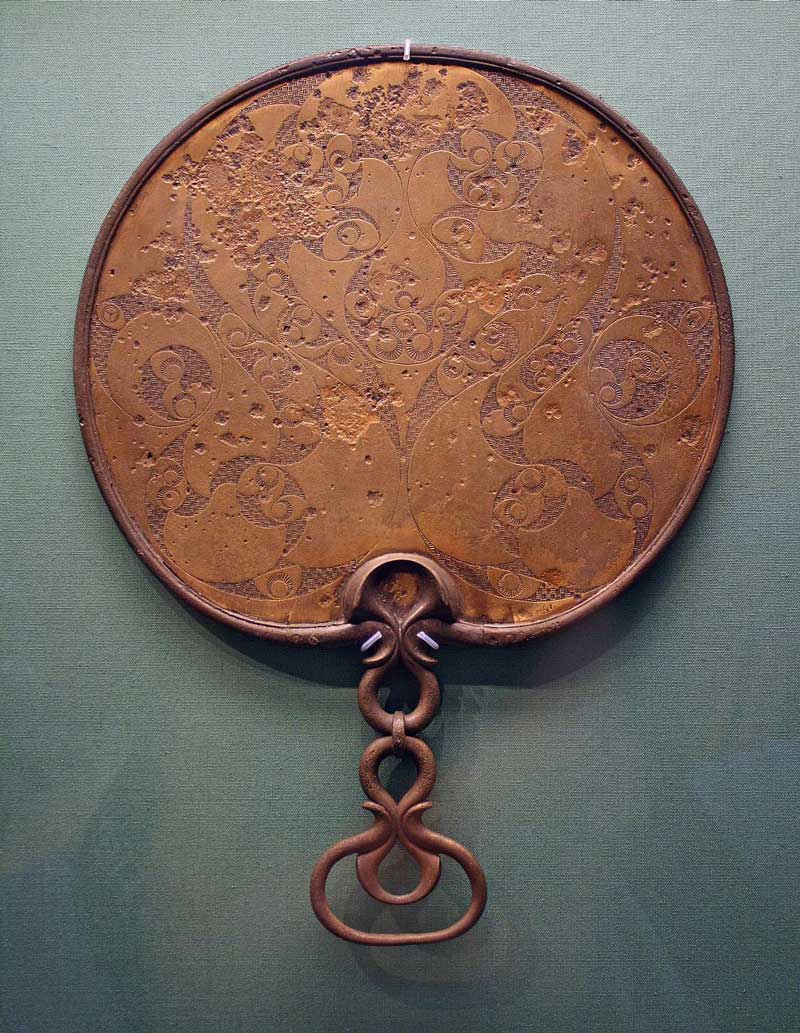
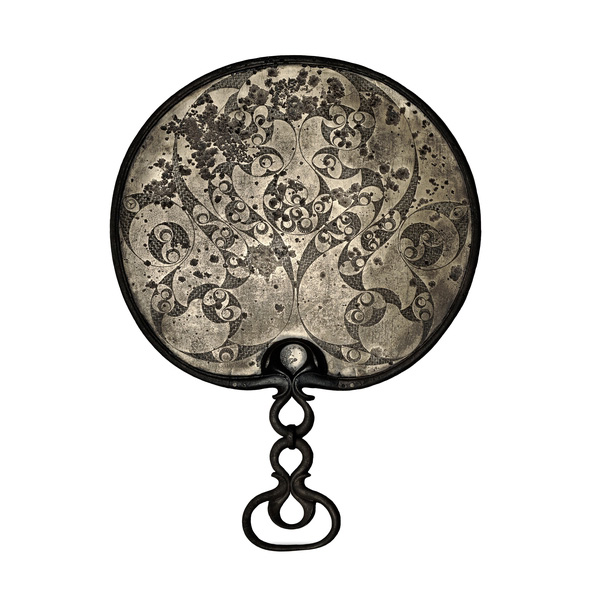
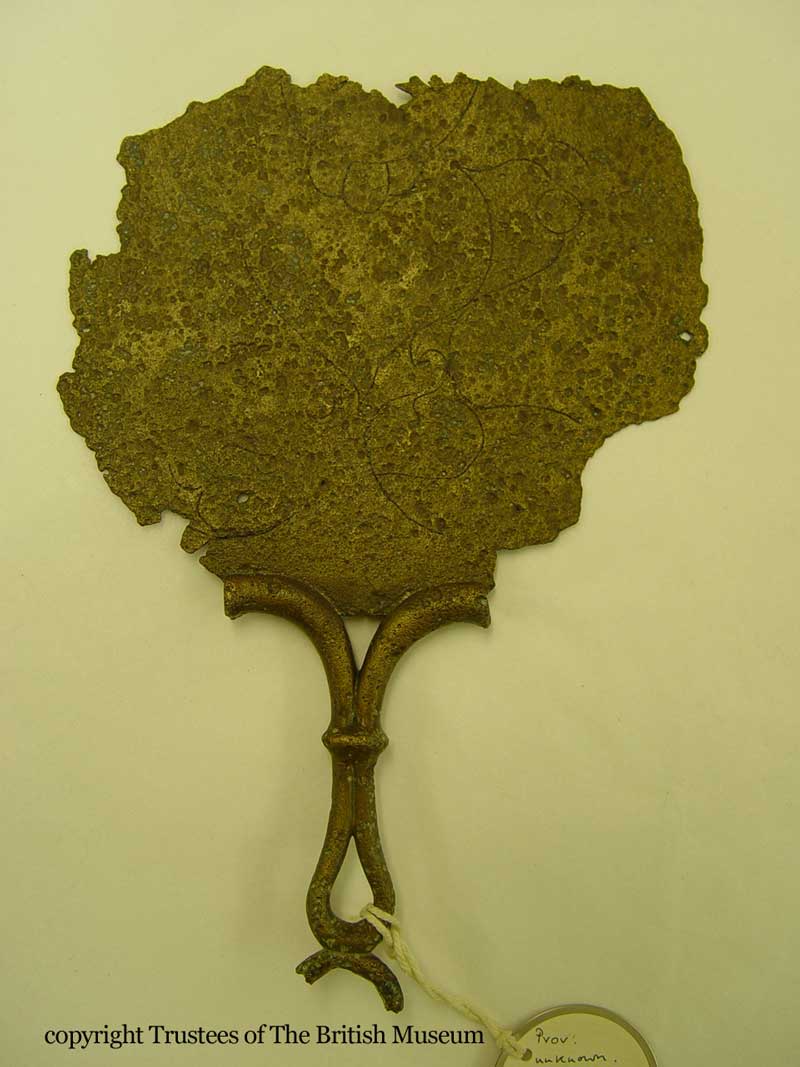
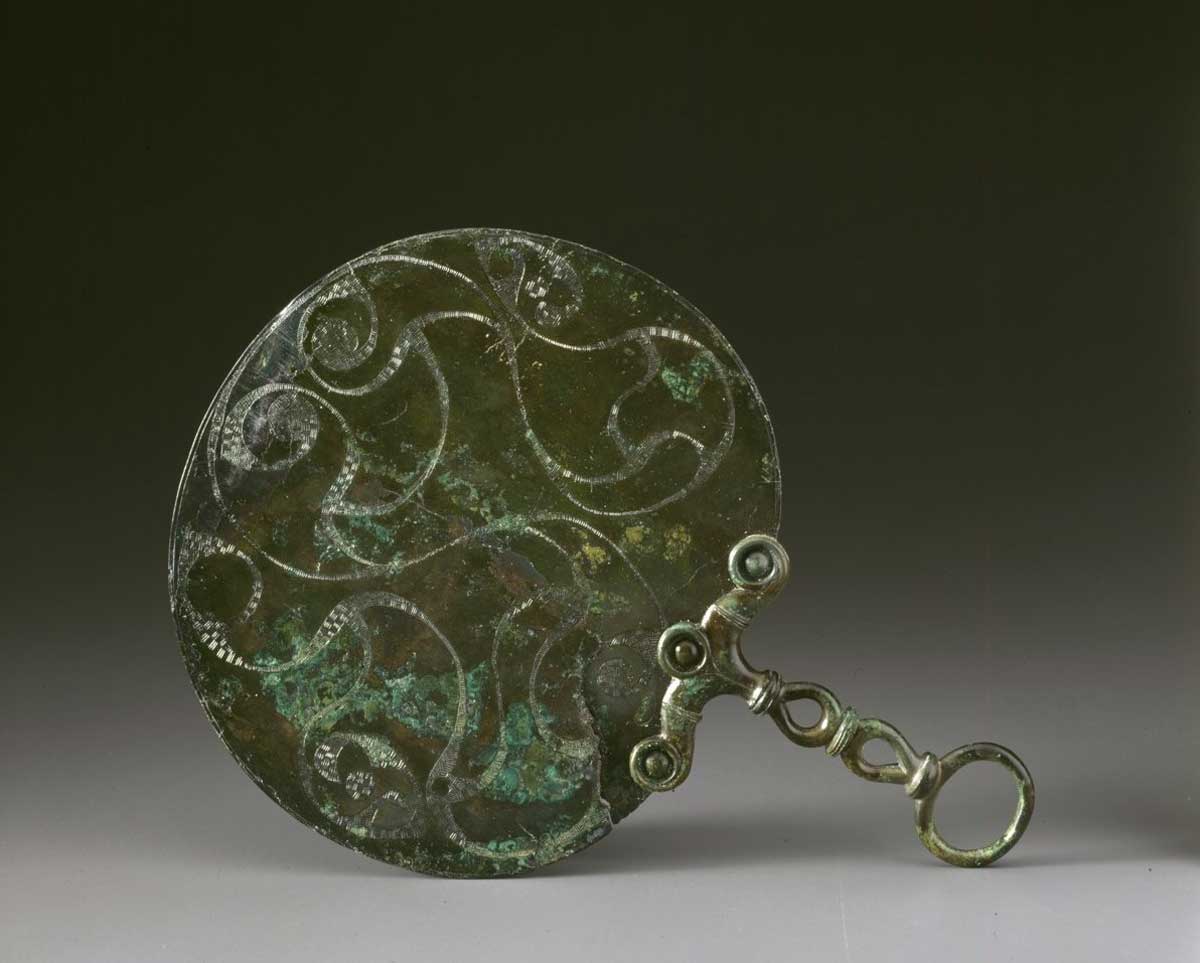
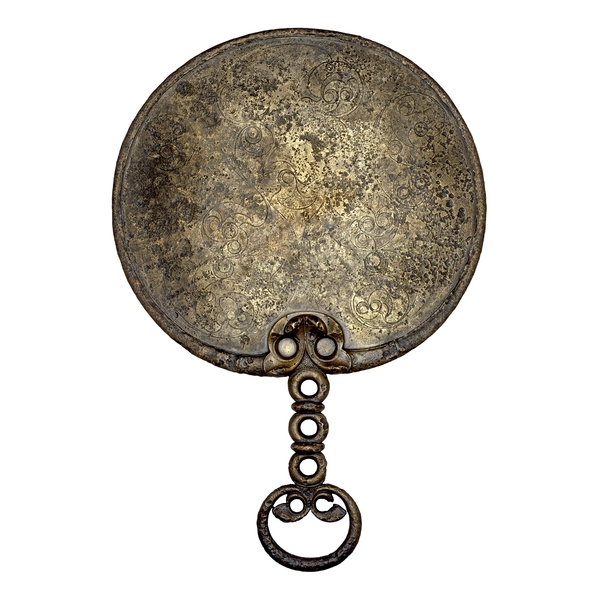
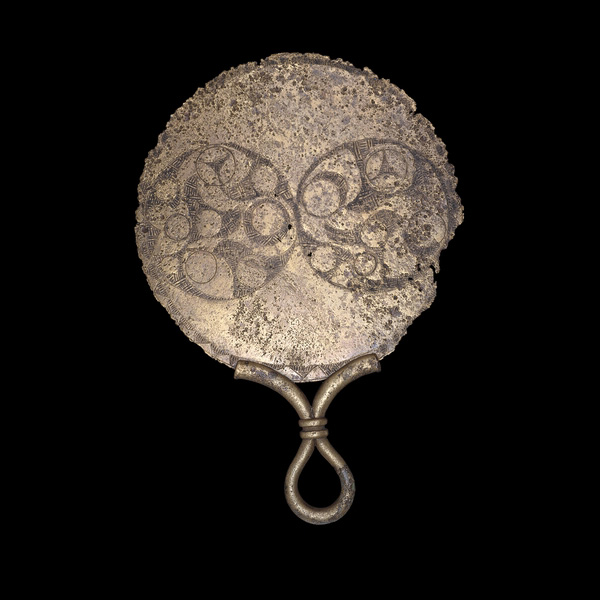
| 1 | Aston mirror; British Museum, London, UK | Description: “Incomplete – missing rim. Diameter: 194.00mm Height: 19.4 cm The pattern on the back can be interpreted as an abstract or hidden face. The very fine lines of the symmetrical pattern were made with a graver, a tool with a hard, sharp edge. In parts of the pattern, lines were made at right angles to each other to make a prominent ‘basket-weave’ effect.” Background: “Iron Age, 50 BC – AD 50 This mirror was probably placed in a Late Iron Age cremation grave, but the grave was destroyed by ploughing. The main part of the mirror was found by a farmer, the handle found the following year.” -Source: British Museum, 8/12/09 PDF Excavated/Findspot: Europe, British Isles, England, Hertfordshire, Aston (Hertfordshire). Acquisition Details: “The Aston mirror has the accession number 1979,1002.1 and 1981,0504.1 because the mirror plate and the handle were found separately in 1979 and 1981.” Gift of W.S. Jefferies For more information about the Aston mirror click here. PDF | |
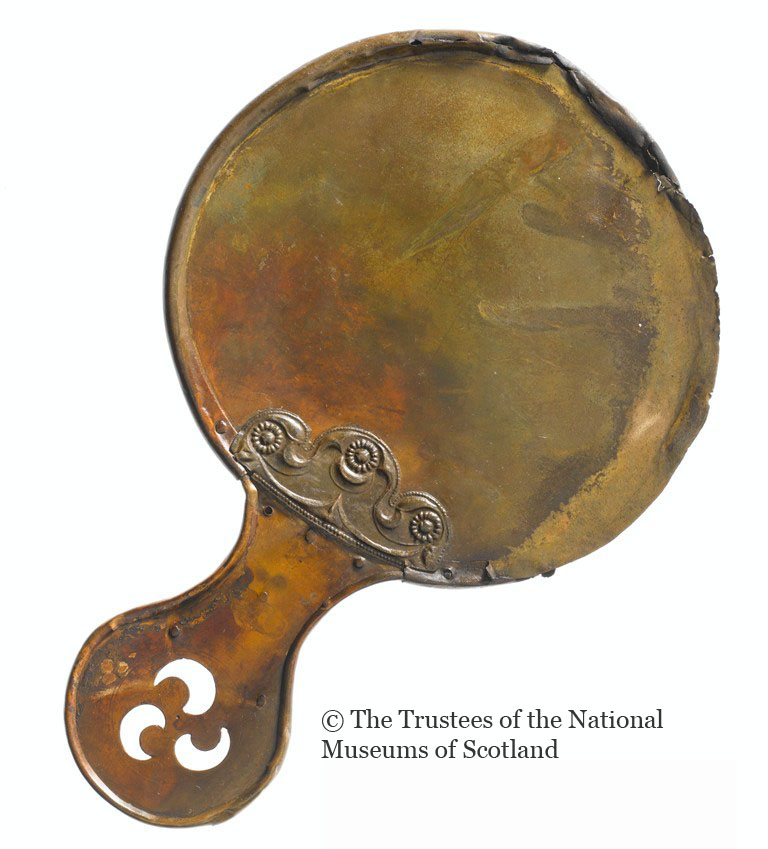
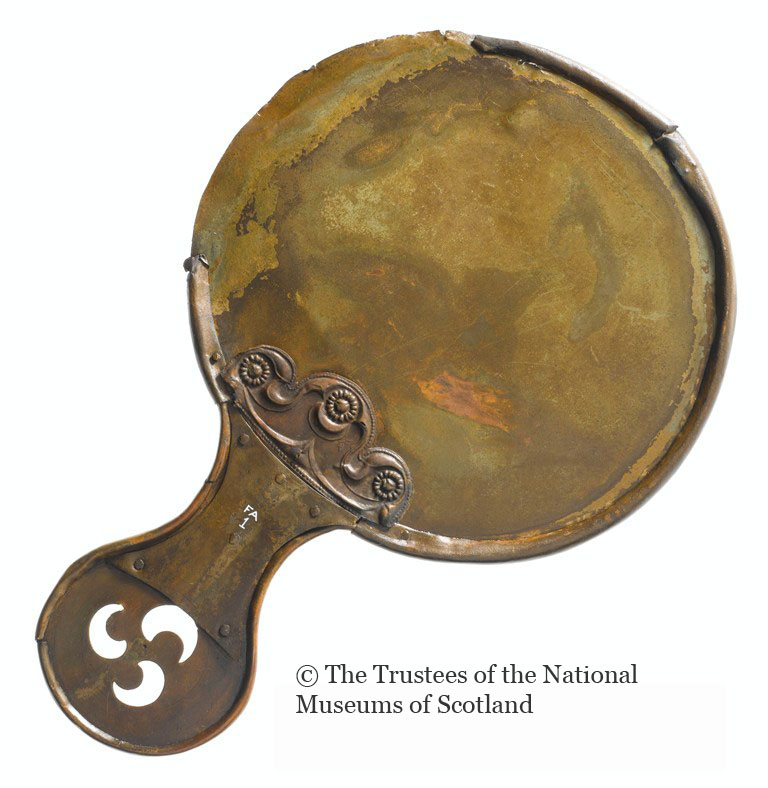
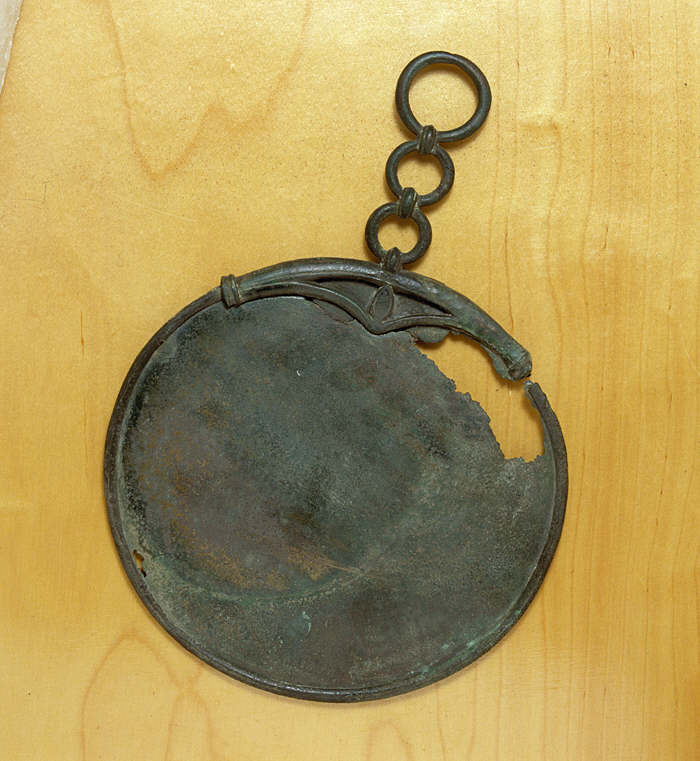
| 2 | Balmaclellan mirror; National Museum of Antiquities, Edinburgh, UK | Description: Reconstructed from fragments. “Bronze Circular Mirror, measuring 13 inclies in length including handle, with embossed ornaments on each side, and handle ornamented with triple perforation; a Crescent-shaped Plate of Bronze, ornamented with incised scroll patterns its greatest diameter measures 13 inches, and across the plate 2 inches ; also various portions of triangularly-shaped Bronze Plates, with two ornamented studs or buttons, and Bronze Belts with pieces of coarse linen cloth found intrenching a moss in the parish of Balmaclellan, New Galloway.” -Source: Archaeology Data Service, ads.ahds.ac.uk, 8/21/09 Background: 1st century BC — mid 1st century AD Southwest Scotland. “Found in the parish of G-irthon, Galloway. A bog was being drained for agricultural purposes, and the workman in cutting the drains, which are from 2-J to 3 feet deep, came upon a peculiar-shaped stone, which he threw aside and afterwards took home with him. Sometime after the drains were cut, the farmer himself was clearing them out with a hoe, preparatory to setting the stones, here largely used instead of tiles; and, close by where the quern was found, he came upon the bronze circular-shaped mirror, with the crescent-shaped ornament.” -Source: Archaeology Data Service, ads.ahds.ac.uk, 8/21/09 National Museums Scotland Acquisition Details: ? |
|
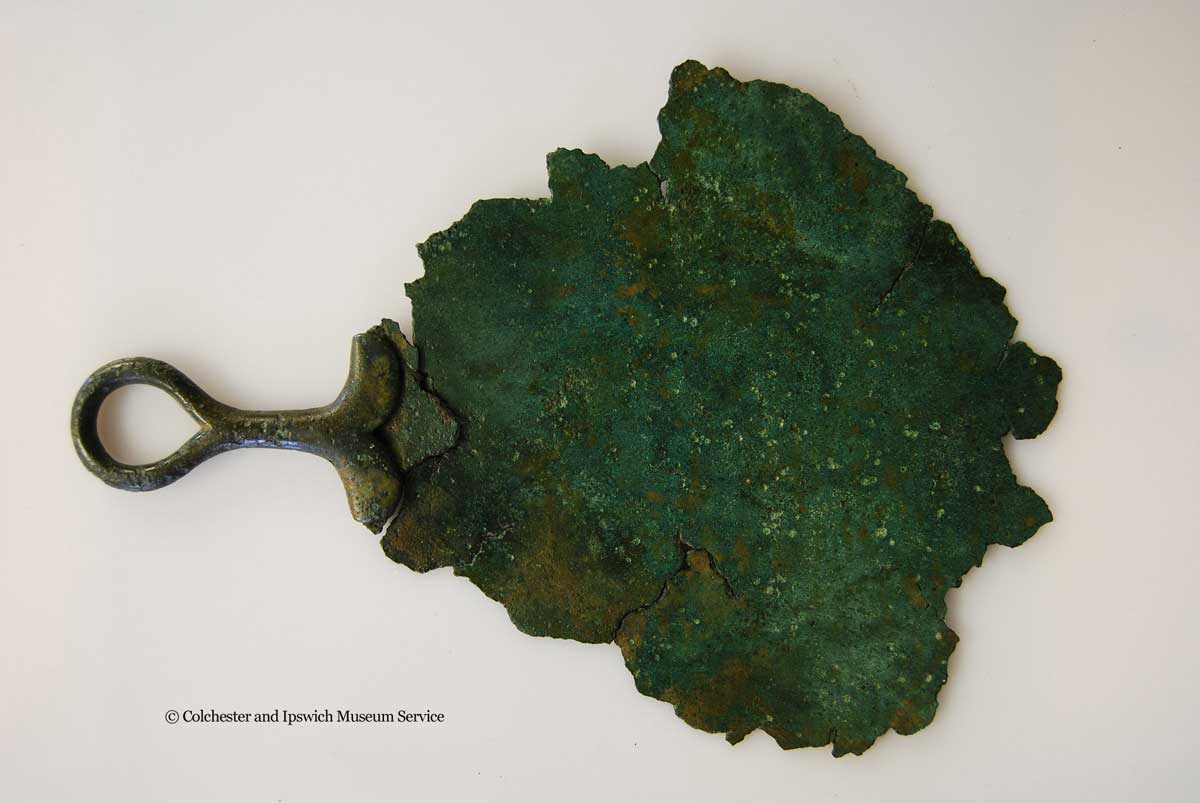
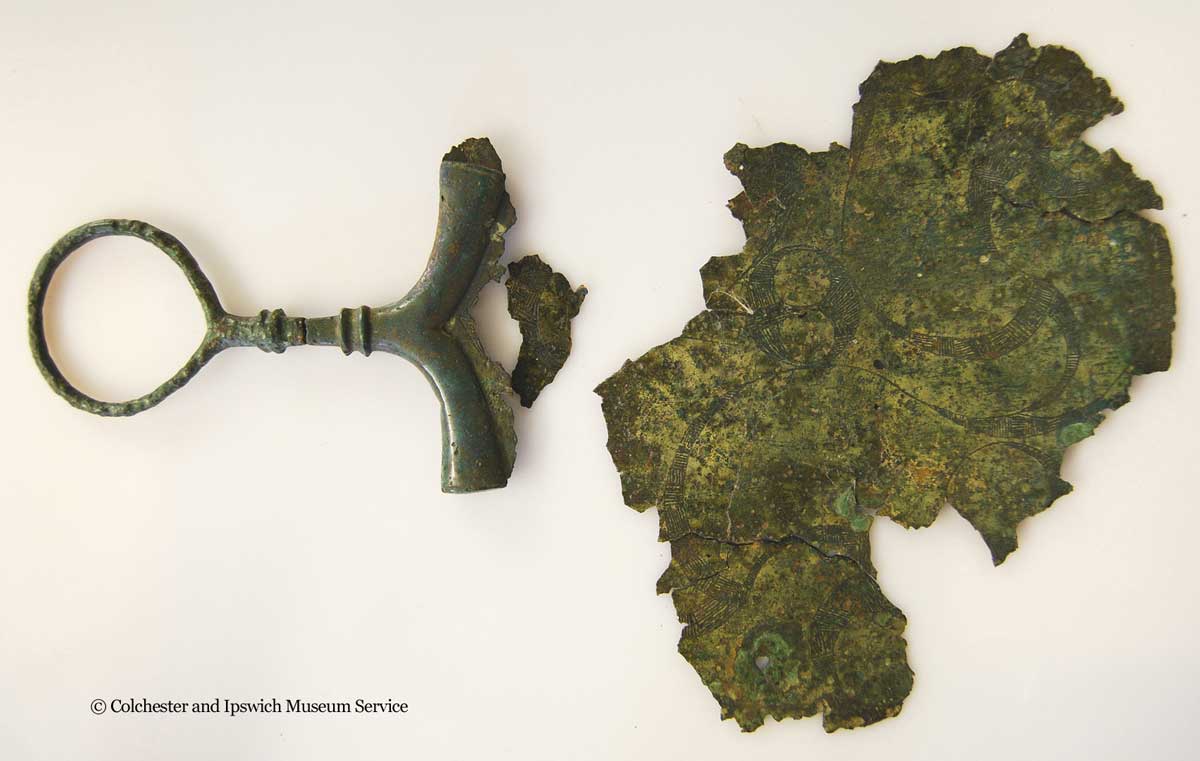
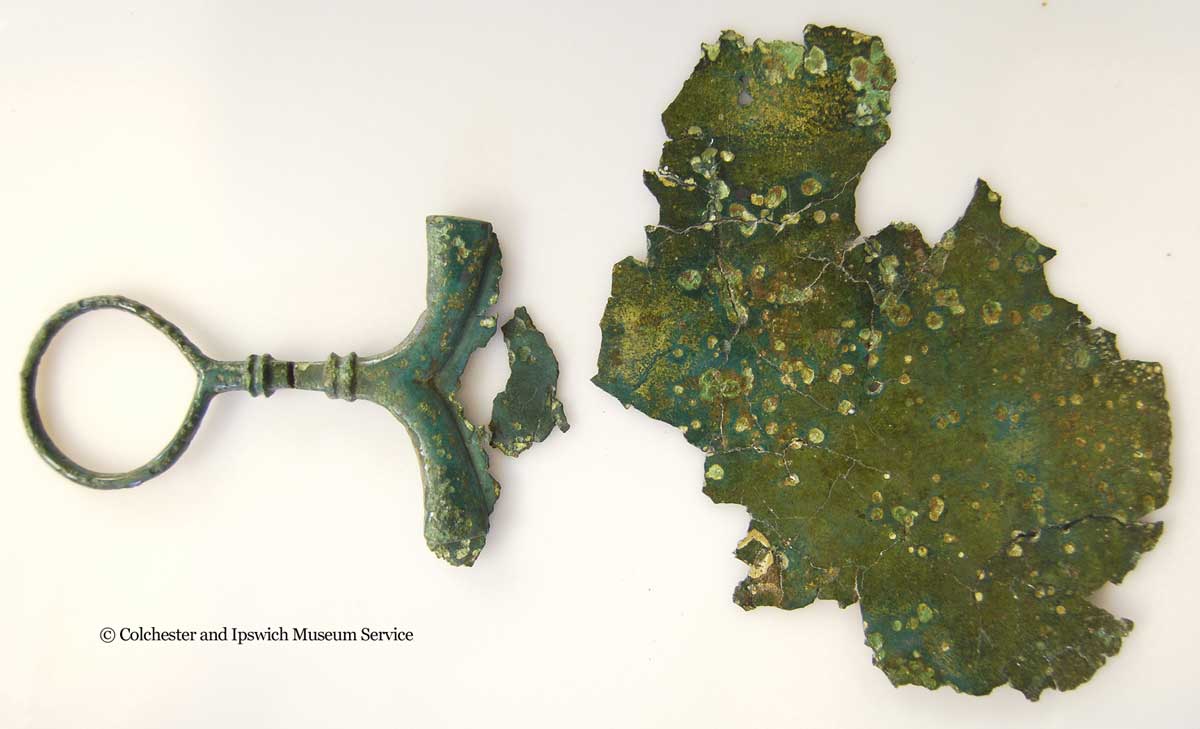
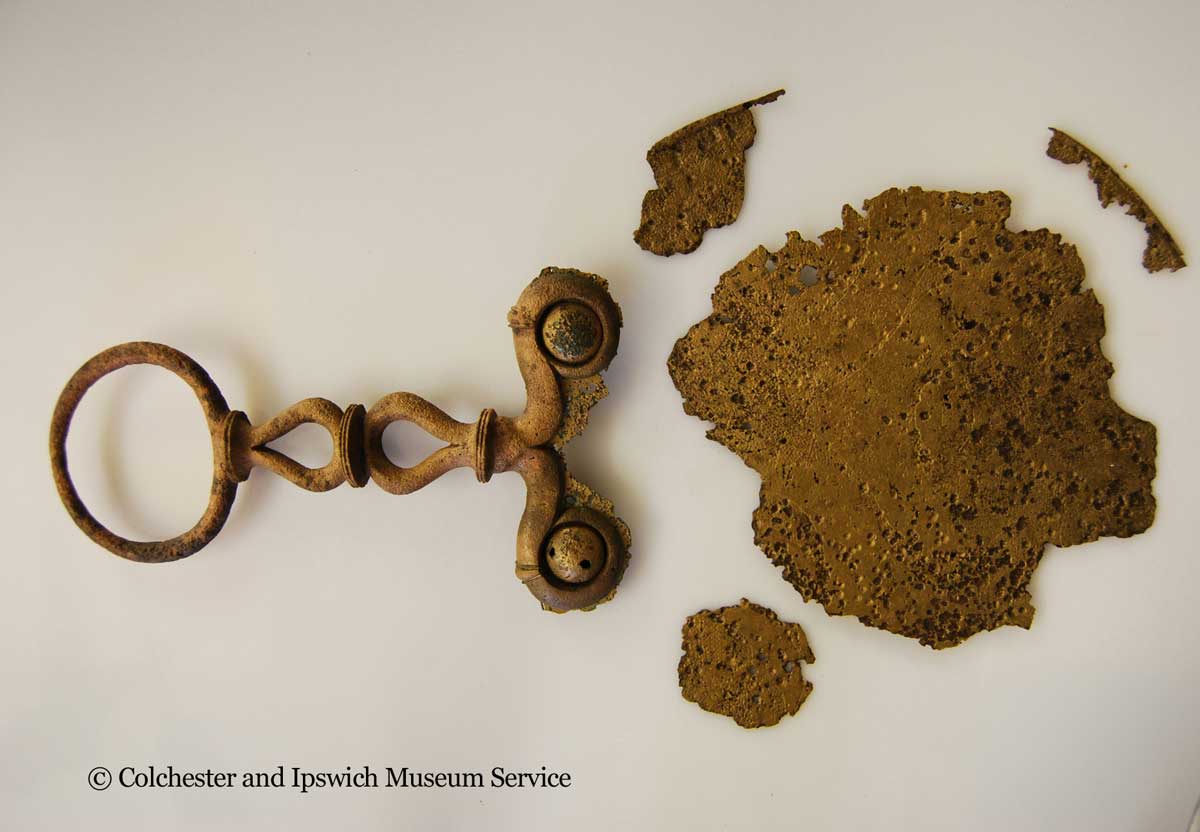
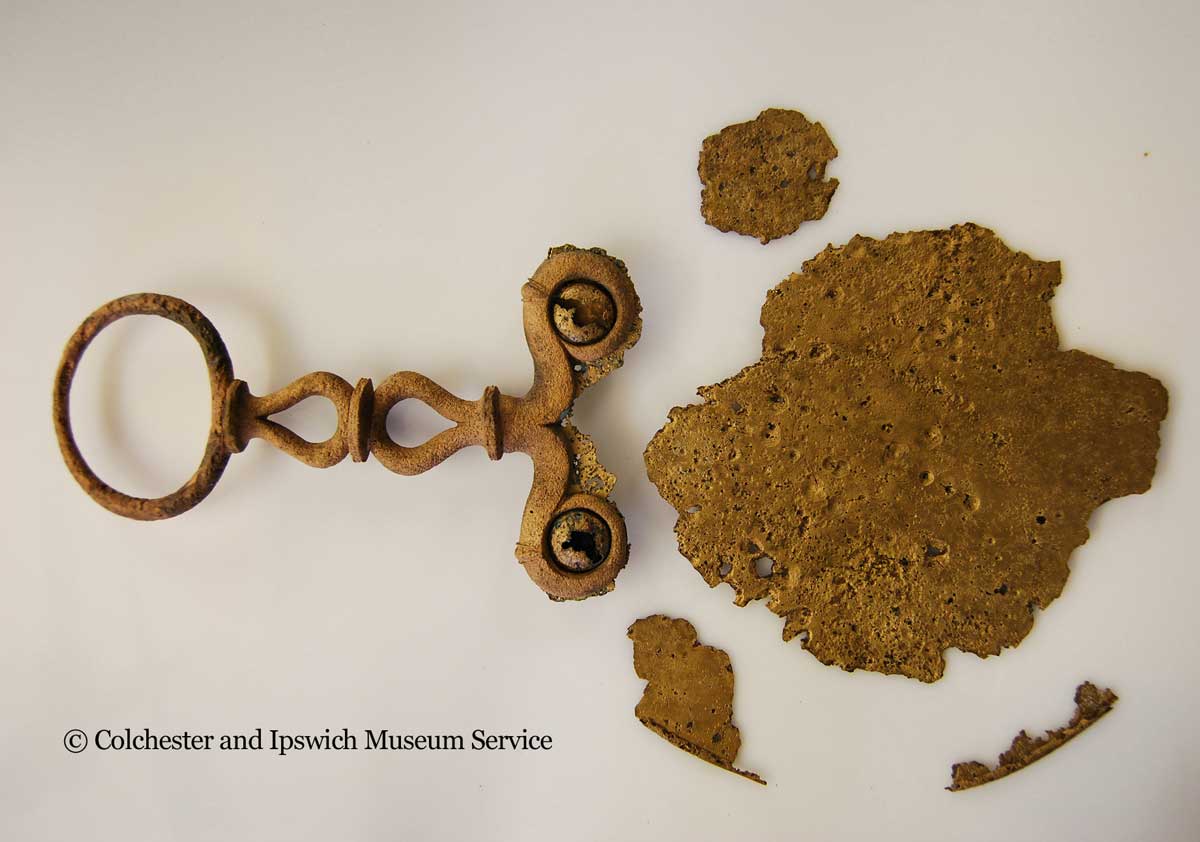
| 3 | Billericay mirror (one); Colchester Museum, Colchester, UK | Description: Fragment – Incomplete. Background: 1st century BC — mid 1st century AD Found circa 1860, probably in a cremation burial, Essex, UK. Acquisition Details: ? |
|
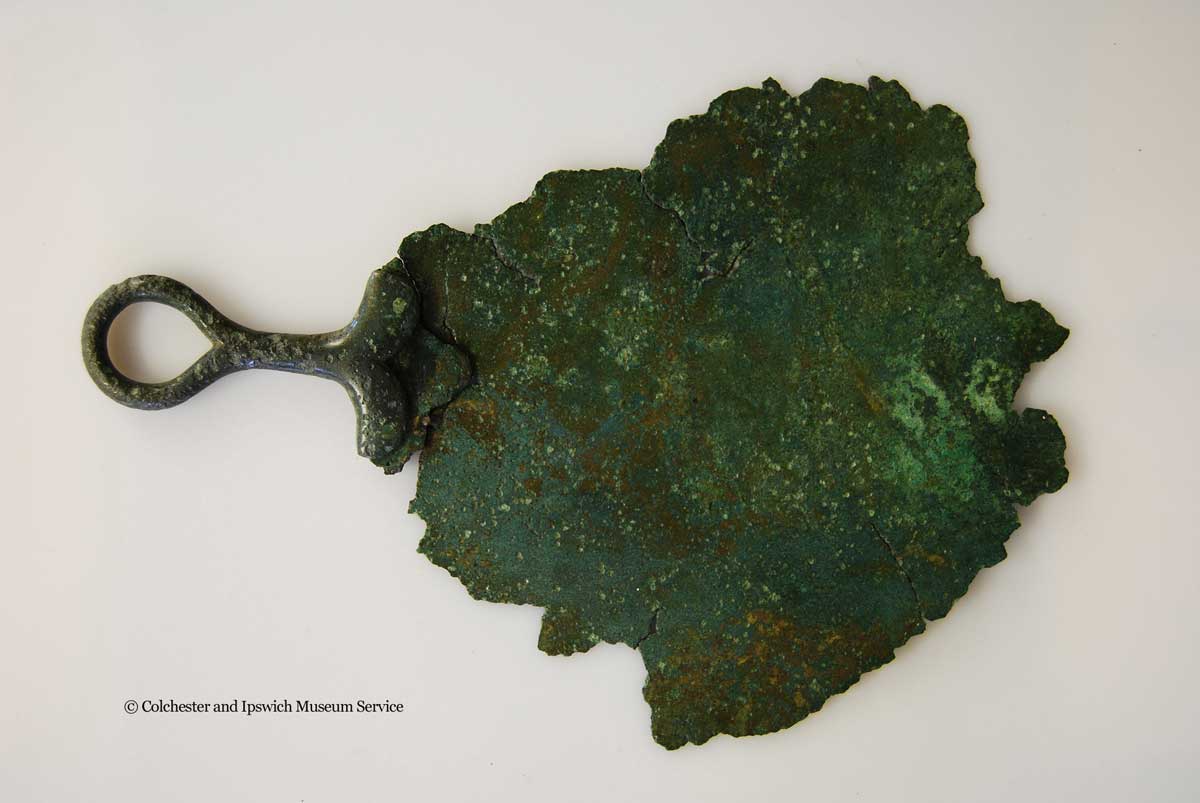
| 4 | Billericay mirror (two); Colchester Museum, Colchester, UK | Description: Fragment with handle. Background: 1st century BC — mid 1st century AD Found circa 1860, probably in a cremation burial, Essex, UK. Acquisition Details: ? |
|
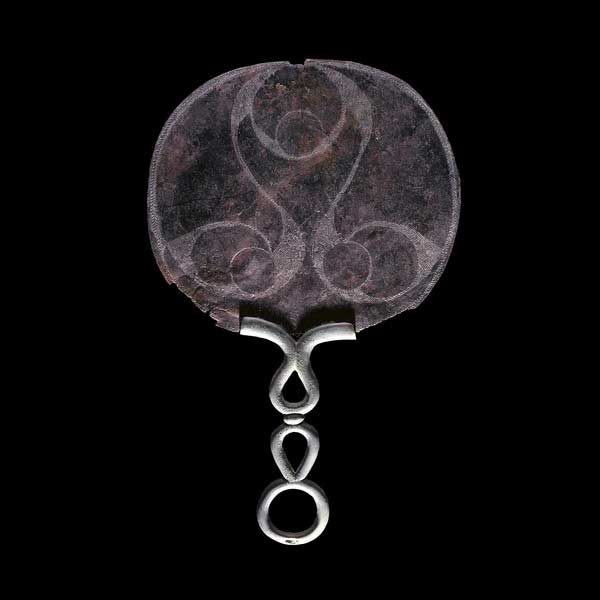
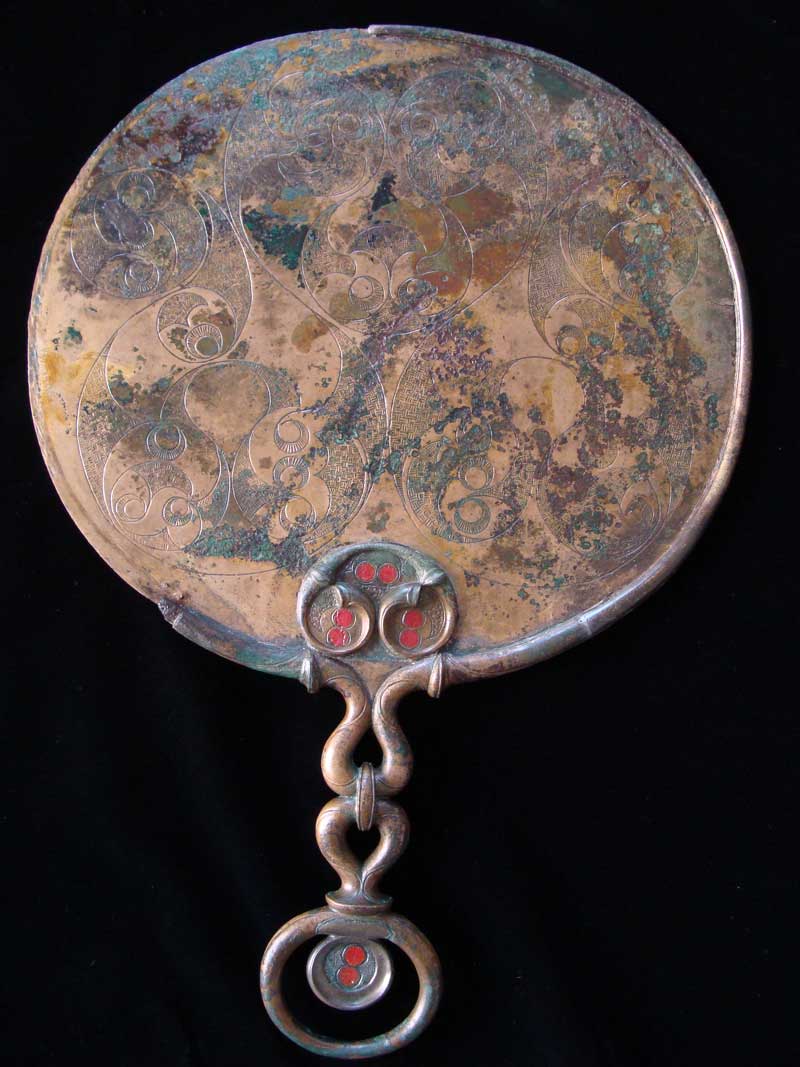
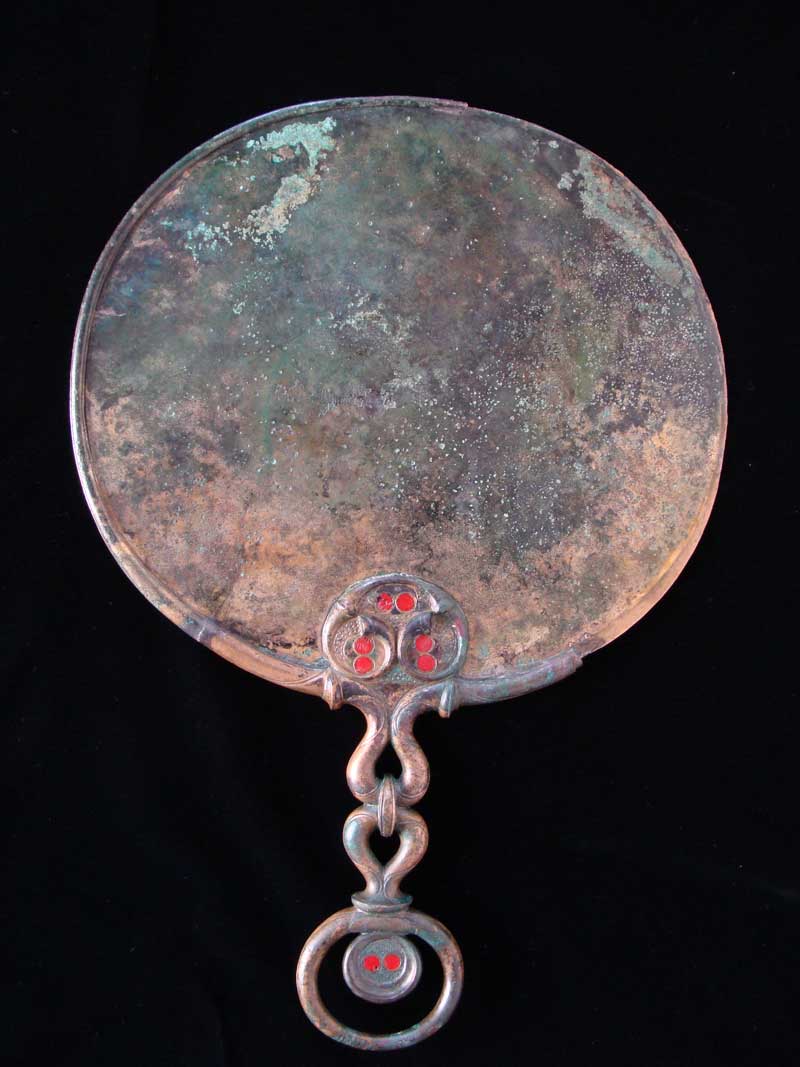
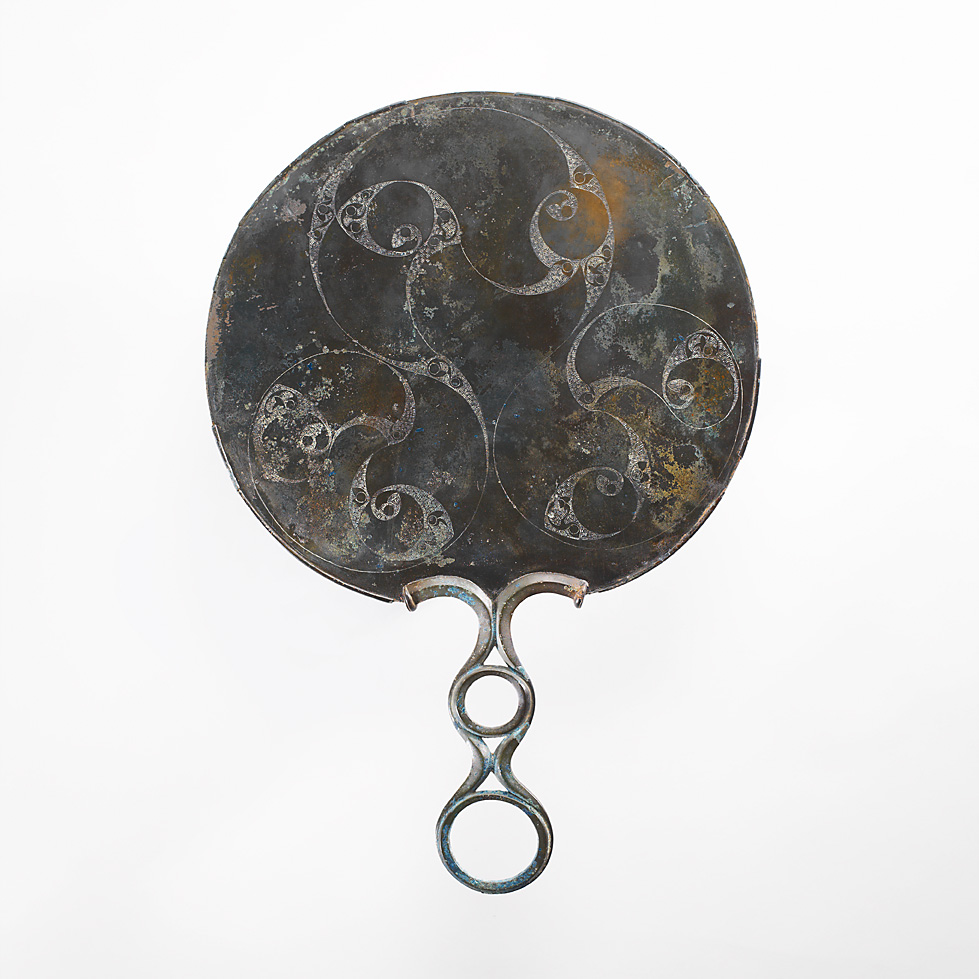
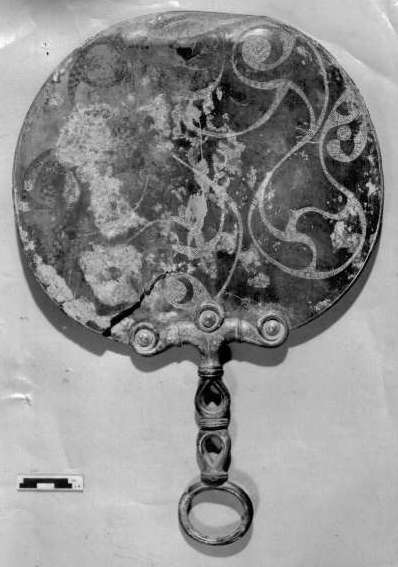
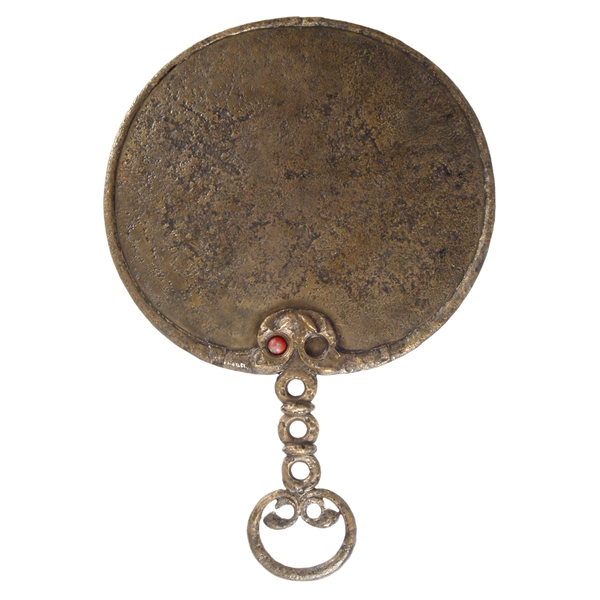
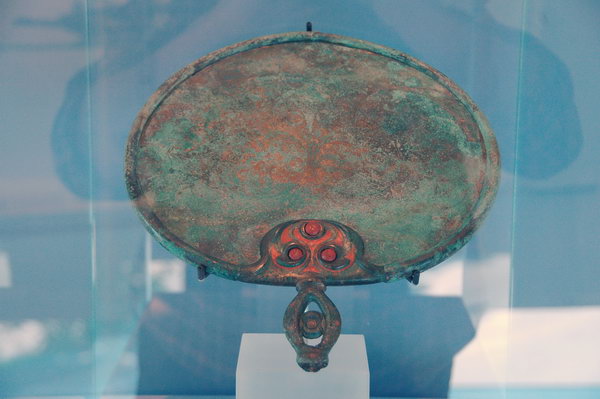
| 5 | Birdlip mirror; Gloucester City Museum, Gloucester, UK | Description: Female burial, Birdlip. Bronze. Intact except for 33% of rim and with heavily pitted surfaces. Height with handle: 381 mm Height plate: 28.7 cm Width plate: 265 mm Length: 38.7cm “The Birdlip mirror design on the back of the bronze mirror is etched in to the metal. The pattern is composed of interlocking triskeles which end in groups of two or three flourishes. The handle of the mirror consists of a series of interlocking loops, the final loop, encloses another smaller circle of metal. Red enamel dots can be found on this circle, as well as on the top of the handle, where the handle meets the body of the mirror. This area could be defined as a pelta, or a small mushroom shape, similar in form to the Egyptian lotus bud.” -Source: University of North Carolina at Chapel Hill, unc.edu, 8/14/09 “It is one of the finest items of British celtic art to survive today, and perhaps the finest example housed outside a national museum.” -Source: "Birdlip Grave Group Mirror Construction," Gloucester City Council, gloucester.gov.uk, 8/14/09 Background: 1st century BC — mid 1st century AD Discovered in 1879, found in Female burial, Birdlip Gloucestershire. “Buried with a group of iron-age treasures around AD 50 along with the owner. In 1879 workmen discovered three skeletons in a quarry between Crickley and Birdlip overlooking the Vale of Gloucester. With the bones were some amazing Iron Age artifacts. The most important object is a handheld mirror of bronze.” -Source: "The Birdlip Grave Group," Gloucester City Council, gloucester.gov.uk, 8/14/09 Acquisition Details: Purchased from the finder by a local business man. Presented to the museum in 1880. For more information about the Birdlip mirror, contact the Archeology Curator, Gloucester Museums Service, Regeneration (per email 8/3/2009) (per an email of 5/5/2020 – David Rice has been retired from the Gloucester city museum for some years and there are no updates on a replacement.) |
|
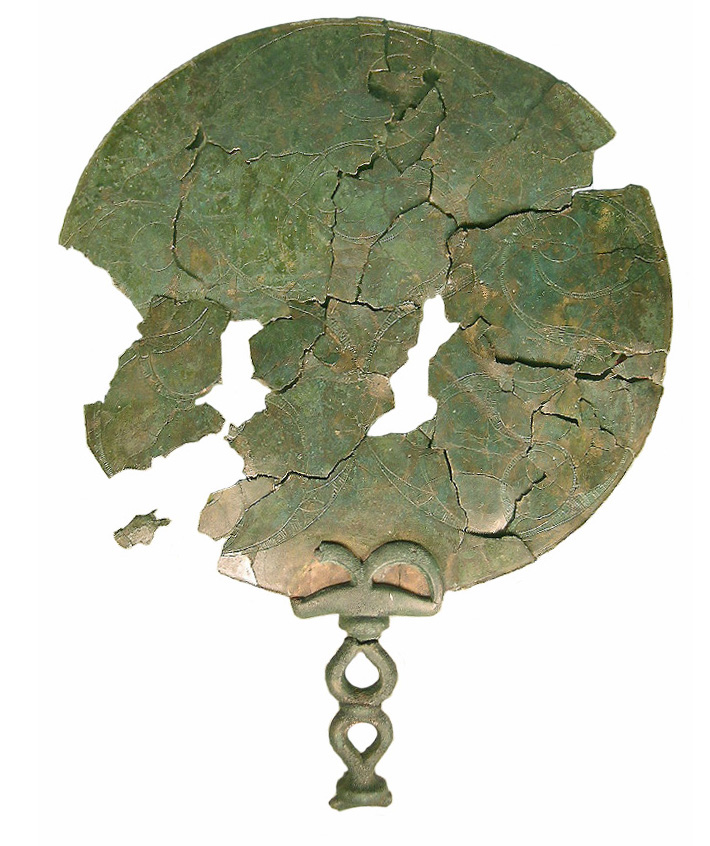
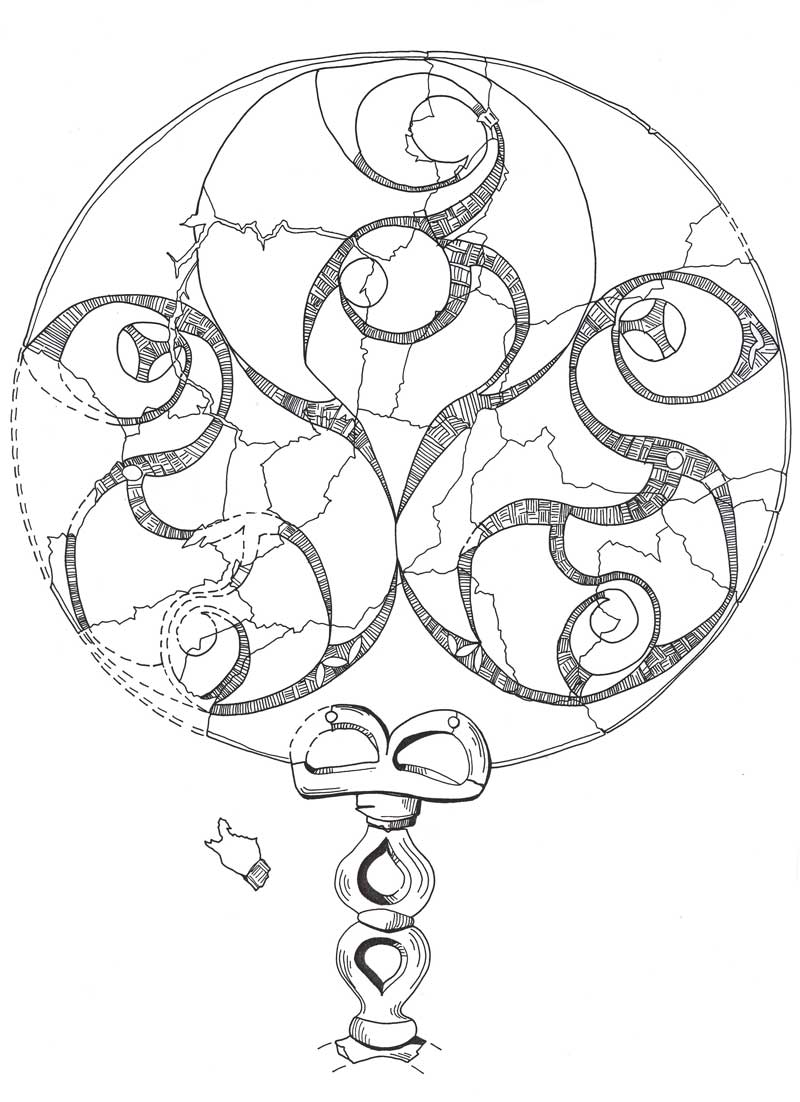
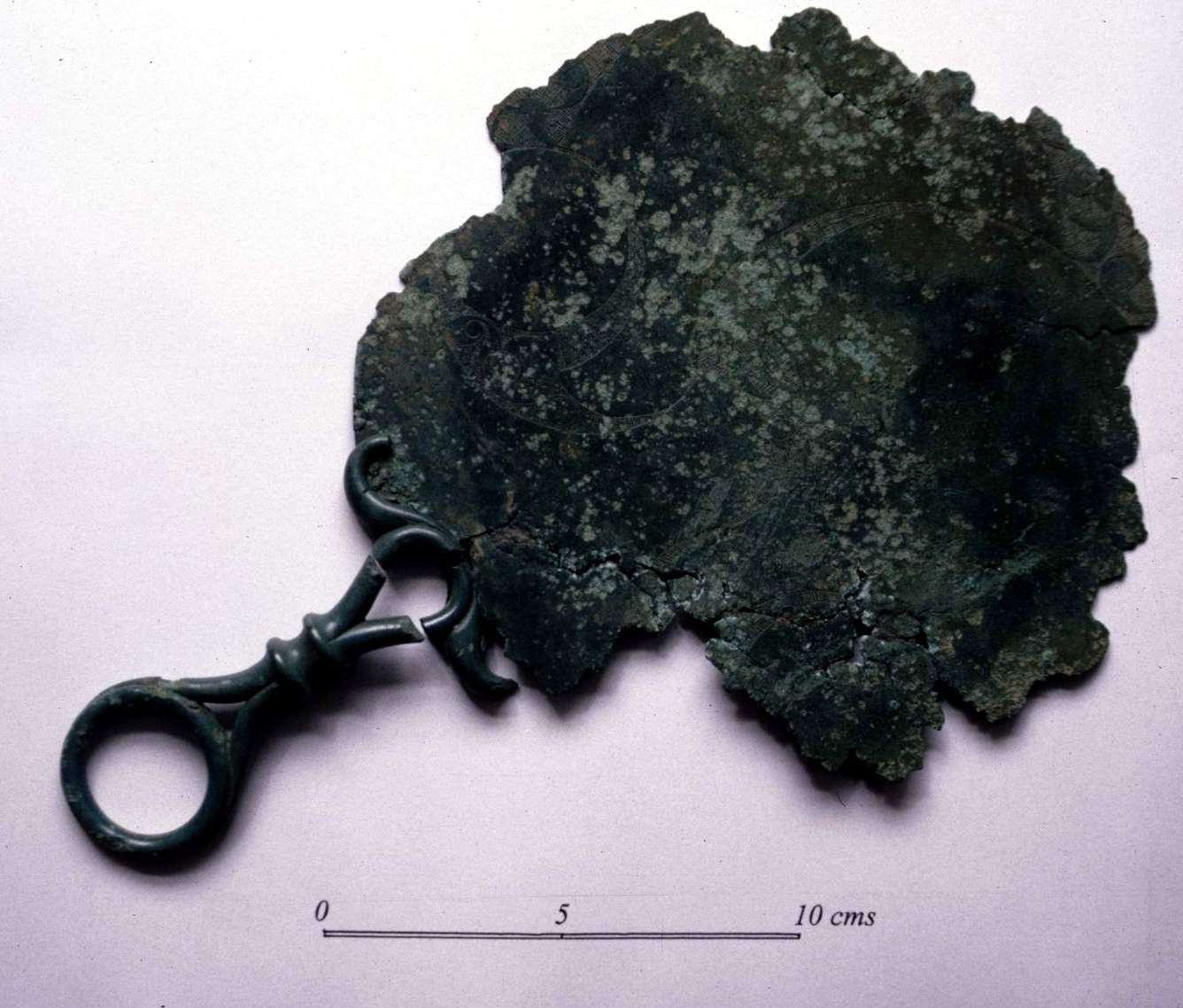
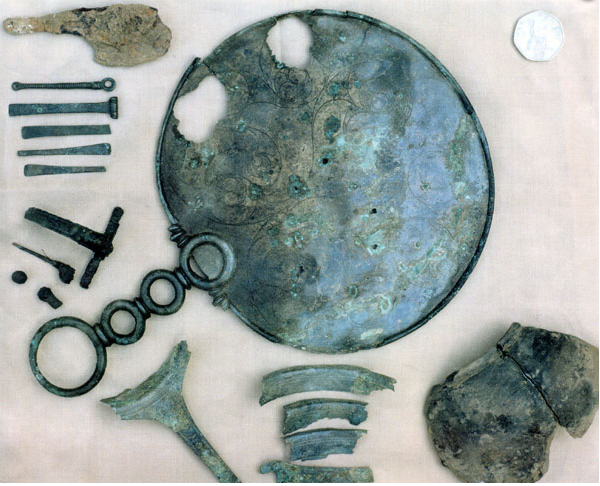
| 6 | Bromham mirror; Verulamium Museum, Hertfordshire, UK | Description: Broken & Incomplete. Height: 25.5 cm Width: 21.5 cm “A fragmentary and incomplete bronze mirror of late Iron Age date. It is suggested that the piece dates from the 1st century BC, since it lacks the kidney-shaped plate and binding strip of later examples. Sixteen fragments of the object were recovered from the topsoil and subsoil and represent approximately three quarters of the original artefact. These pieces were spread across an area of approximately 300 square metres, probably as a result of deep ploughing. Overall, the reconstructed object is 255mm high and weighs 265.5g. The plate is oval and measures up to 215mm wide by 190mm high and 1mm thick. The reverse has an engraved symmetrical pattern. This is comprised of a series of swirling lines and circles forming a triple lobe ‘lyre’ arrangement typical of mirrors of this period. The outline pattern has basketry infill made up of an irregular series of blocks of decoration containing either parallel horizontal or vertical incisions. These are broken up with occasional insertions of circles or petal-shaped incisions. The design is surrounded by large amounts of blank space and is stylistically similar to examples from Dorton in Buckinghamshire, Bramley near Silchester, Rivenhall, Old Warden (Bedfordshire) and Great Chesterford (see references below). The outer edge of the plate is marked by a narrow raised rim. The reverse is plain. It has a deep green patina. The handle is of cast bronze. The top of the handle consists of a pair of double semi-circular openwork attachments. These are separated by a transverse slot into which the mirror plate is fitted. Two copper-alloy rivets of circular section, located at the top of the semi-circular attachments, serve to join the plate to the handle. This attachment is damaged and incomplete on the reverse. It gives way below to a circular moulding which, in turn, gives way to the rest of the handle (now detached). This remaining portion of the handle is comprised of two bronze loops separated by a circular moulding. A further moulding sits between the base of the lower loop and an attached fragment of what was presumably a base ring (now missing). The surface of the handle is heavily pitted.” – Source: Julian Watters, Finds Liaison Officer for Hertfordshire and Bedfordshire, 9/11/09 Background: 1st century BC — mid 1st century AD Found October 2004 in Bromham, Bedfordshire, with metal detector. “At a rally of the Weekend Wanderers Metal Detecting Club in Bromham, Bedfordshire in March 2004, Mr. Clifford discovered a fragment of rare decorated bronze mirror of late Iron Age date. Such mirrors are unusual finds and excavated examples are generally found in female graves. Over the course of the day, fifteen more fragments of the mirror were recovered by club members. The locations of the heavily plough-damaged artifacts were recorded by Julian Watters using a handheld GPS device. Phil Carter (Verulamium Museum) is currently working on the reconstruction of the mirror.” -Source: British Museum, finds.org.uk, 8/18/09 PDF Acquisition Details Verulamium Museum, Bedfordshire, England. For more information about the Bromham mirror, click here. PDF |
|
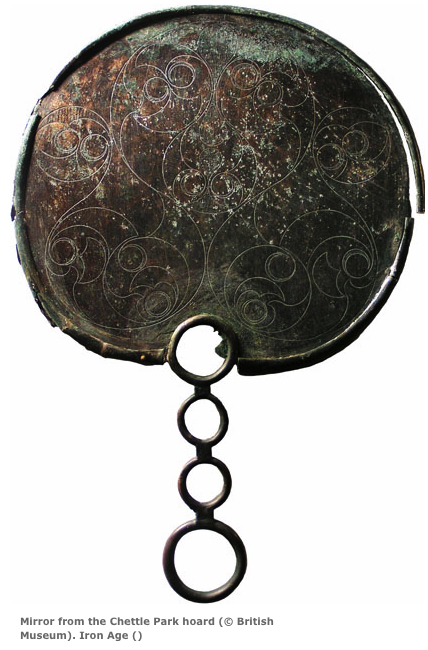
| 7 | Chettle Park hoard; British Museum, London, UK | Description: Dimensions: 23.5 x 21cm “This mirror is decorated with an exquisite geometric La Tène design. The decoration is the most beautifully executed example known to date (60 mirrors of this period are known from Britain). The Chettle mirror complements other mirrors in the British Museum’s collections, particularly Desborough and Holcombe but is of greater artistic note. The museum is embarking on the first systematic full-scale study of Iron Age mirrors in Britain for over a century. The mirror forms part of a larger rare burial hoard and the museum hopes to display the hoard together with a focus on the mirror and its uniqueness and skill of decoration.” – Source: Mirror from the Chettle Park hoard, artfund.org, 8/27/09 PDF Background: Iron Age 1st century BC — mid 1st century AD “Found by a metal detectorist in Chettle Park, Dorset as part of an assemblage of bronze and glass objects by metal detectorists in August 2003.” Acquisition Details: Grant Paid: £18,000 (Total: £18,000) ArtFunded in: 2009 Vendor: Department for Culture, Media and Sport For more information on the Chettle Park hoard mirror, click here. PDF |
|
| 8 | Chilham-Castle mirror; Museums, Libraries and Archives Council, London, UK | Description: British Iron Age Length: 188 mm Plate measures: 126 mm x 136 mm “The elegant copper-alloy mirror dates back to 75 BC, around a century before the Roman conquest. It is approximately 19 cm high by 13 cm wide, and is made up of a roughly circular plate delicately engraved with Celtic ornament, and a looped handle. The reflective surface would originally have been a shiny gold colour, suggestive of sunlight.” Background: circa 75 — 25 BC The mirror was found in a high-status grave, and may have had a religious, as well as a utilitarian function. “The mirror, together with the brooches, was discovered by a metal detectorist in a shallow cremation grave at Chilham Castle in Kent in 1993. As the only Iron Age mirror to have been discovered in Kent, only 17 complete decorated mirrors dating from the Iron Age have been found in Britain. This is one of the earliest, and is especially significant because it comes from a known context which was subsequently investigated by archaeologists using modern excavation techniques.” -Source: mla.gov.uk, 8/17/09 Acquisition Details: ? |
|
| 9 | Colchester Lexden Mirror; Colchester Museum, Essex, UK | Description: Reconstructed from fragments. Background: 1st century BC — mid 1st century AD Found in a burial at Lexden Grange, in 1904 (probably from the period of Cunobelin, c. 10 — 25 AD), Colchester, Essex. Acquisition Details: ? |
|
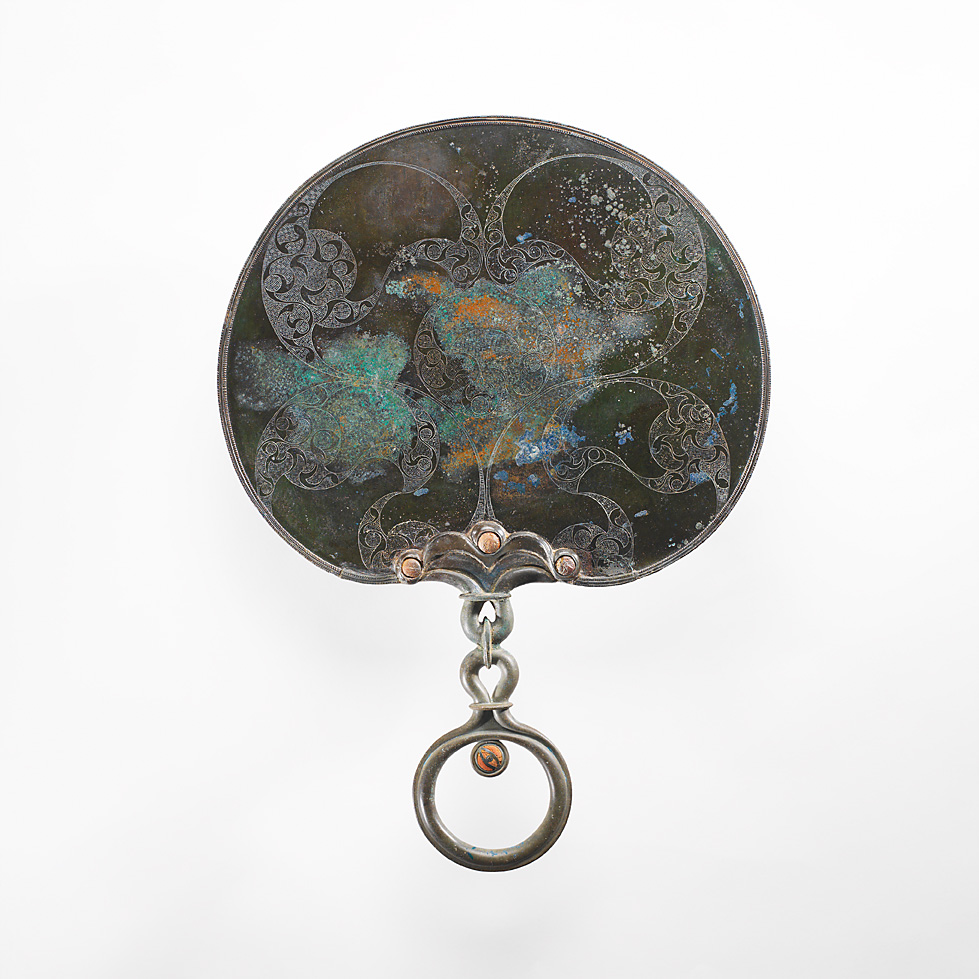
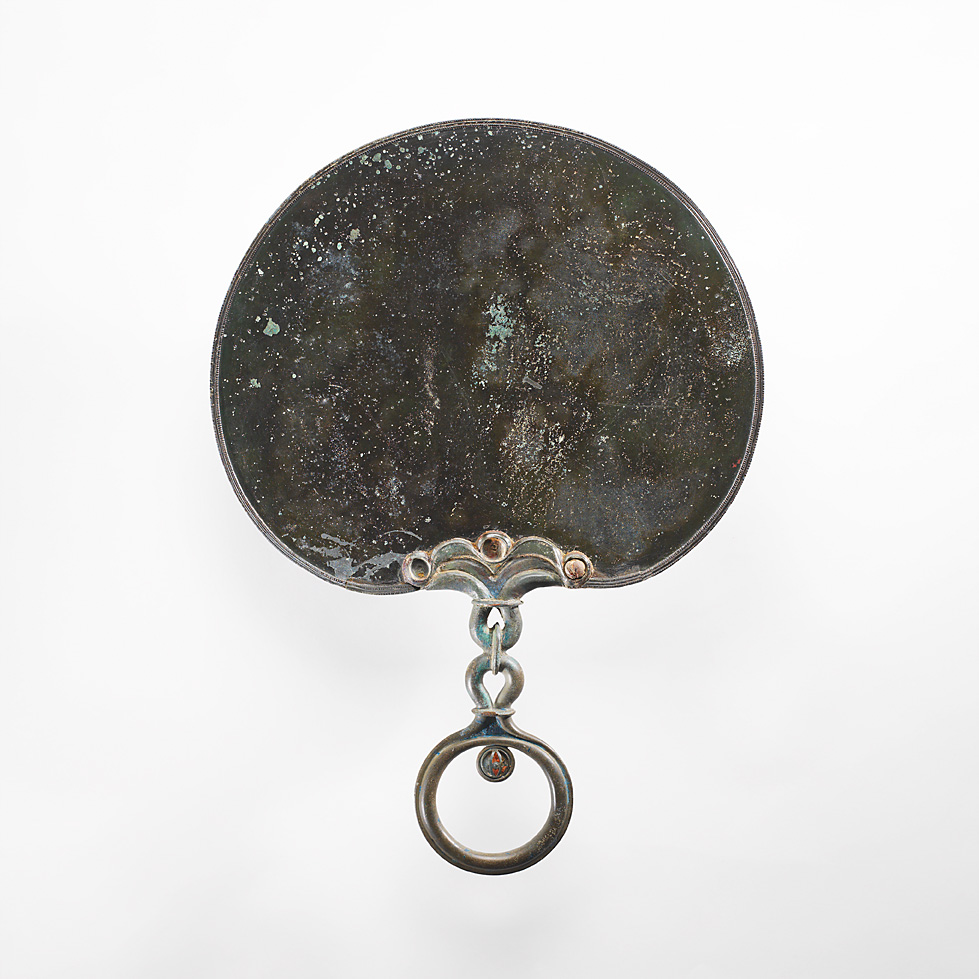
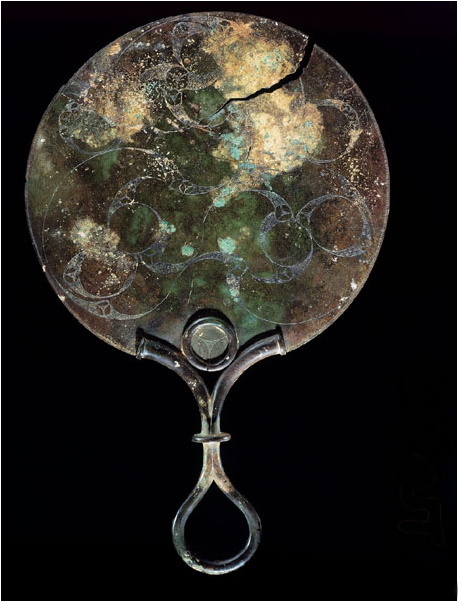
| 10 | Desborough mirror; British Museum, London, UK | Description: “From Desborough, Northamptonshire, England.Decorated bronze mirror—a highlight of British La Tène / Celtic Art. Intact – but with somewhat pitted surfaces. Diameter: 20 cm Length: 35.000 cm The decoration on the back of the mirror and pattern is very complex: a clover-leaf pattern is symmetrically repeated on the left- and right-hand side of the mirror. The pattern may have been laid out using a compass. Recent archaeologists have suggested that mirrors should be seen as symbols of female status and power, making as significant a statement for women as swords did for men.” -Source: British Museum, britishmuseum.org, 8/12/09 Background: Iron Age, 50 BC — AD 50 Found during ironstone digging in 1908 near Desborough village, Northants. Acquisition Details: Total cost in 1924 was £225, paid by a grant from the Art Fund. (A non-government British charity that relies on membership subscriptions and public donations.) |
|
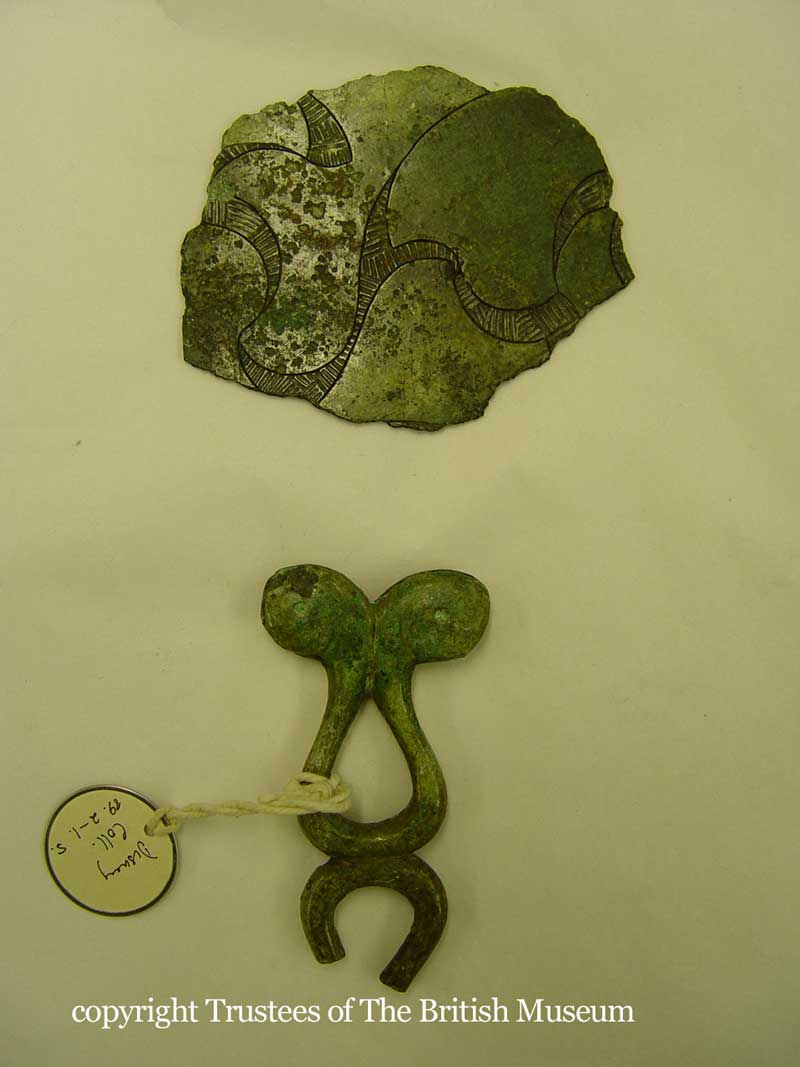
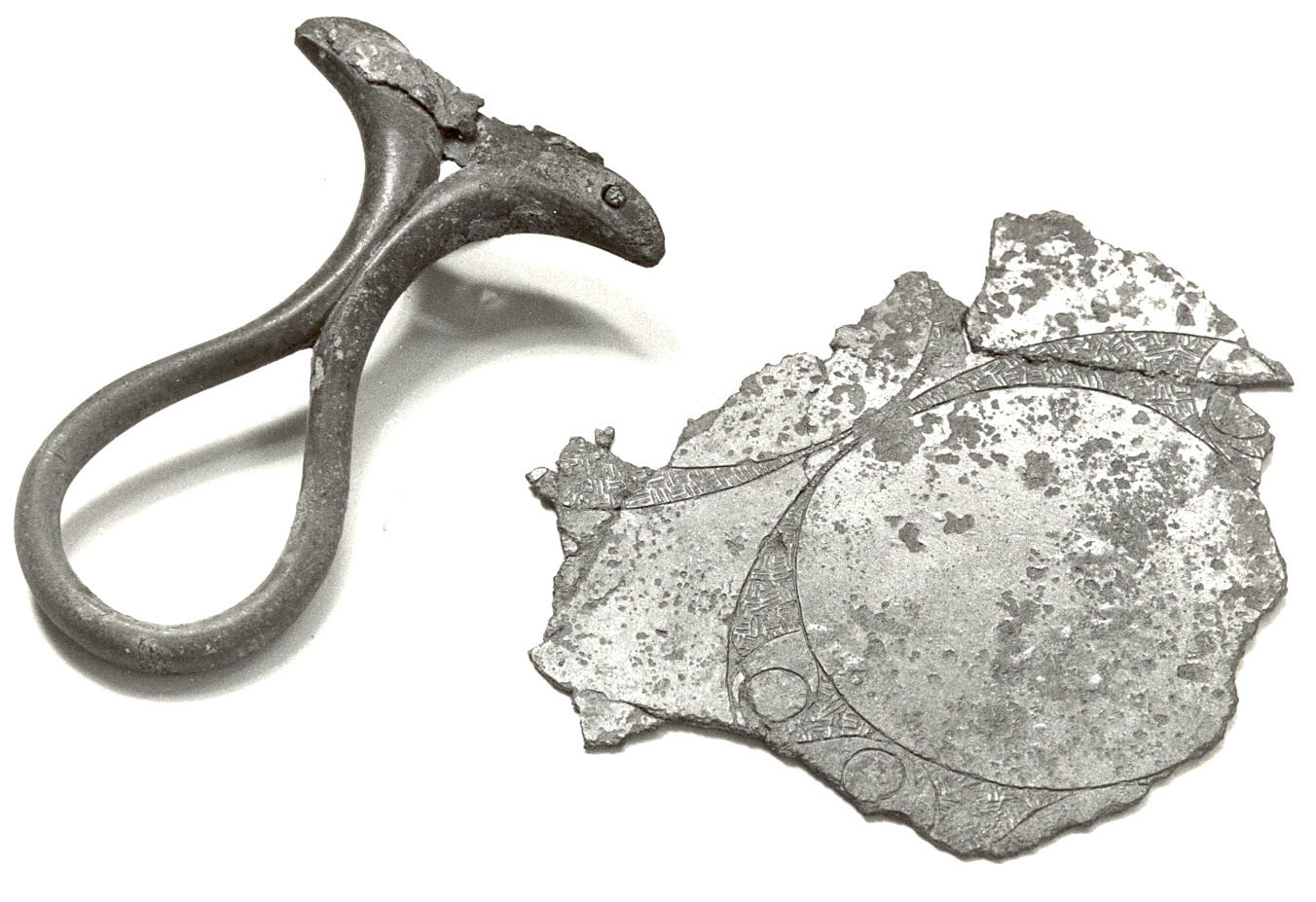
| 11 | Disney mirror (fragment); British Museum, London, UK | Description: Fragment with handle. Background: 1st century BC — mid 1st century AD Acquisition Details: ? | |
| 12 | Dordrecht [Large] mirror; Santa Monica, California, USA | Description: Some corrosion that has been stabilized. Diameter: 26.5 cm “Restoration work done in 2004: Lightly cleaned the heavier encrustations from the disc so as to reveal all design elements and stabilized any remaining copper deposits; Secured the loose beaded borders to the disk; Fabricated a third loop of the broken handle, that which is closest to the disc itself, and permanently reattached the handle to the disc.” Background: Said to have been found in the vicinity of Dordrecht, Netherlands circa 1967. Acquisition Details: Last purchased in 2004. |
|
| 13 | Dordrecht [Small] mirror; Privately held, unknown location. | Description: Intact. Diameter: 21.5 cm Background: 1st century BC — mid 1st century AD Said to have been found in the vicinety of Dordrecht, Netherlands, circa 1967. Acquisition Details: Purchased from Christie’s December 7, 2011 Auction sale for $170,500; Provenance: Private Collection, the Netherlands, 1960’s. | |
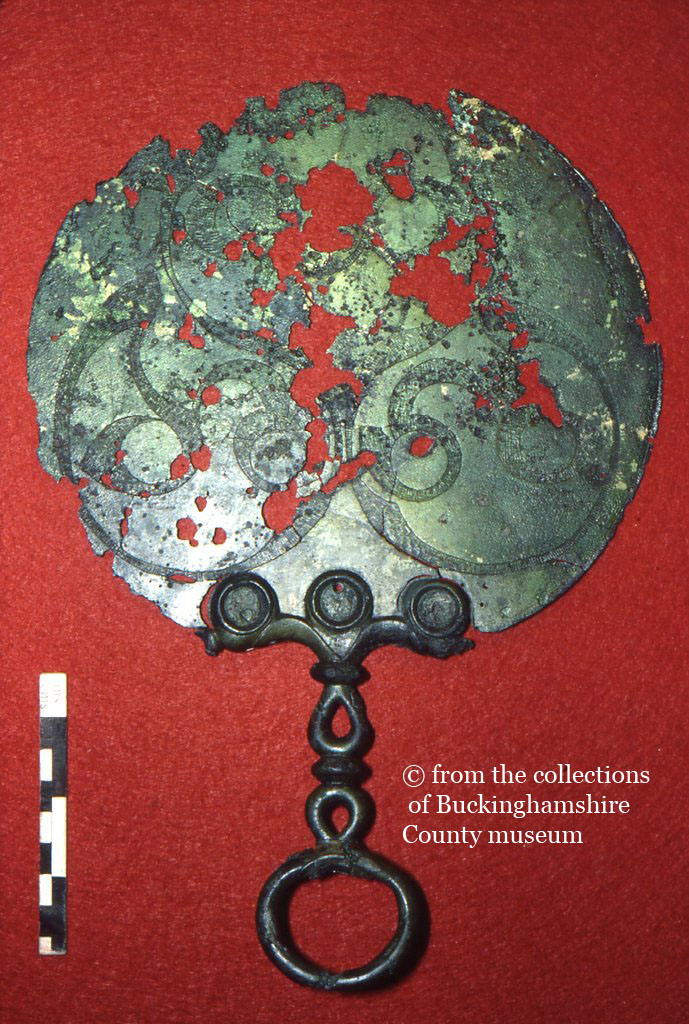
| 14 | Dorton Mirror; Buckinghamshire County Museum, Aylesbury, UK | Description: Reconstructed from fragments. Height: 30.2 cm Background: 1st century BC — mid 1st century AD Bucks, England. “Welwyn style burials have been found at Dorton (Farley, 1983) and possibly Aston Clinton (Bucks SMR 0043); the former producing a fine Late La Tene mirror. None of these burials need be earlier than the early-mid 1st century AD and some are likely to be post-conquest. They reflect the county’s incorporation into the emerging Catuvellaunian “kingdom” – the absence of such burials (so far at least) from the south of the county may be significant, perhaps reflecting a shifting frontier with the Atrebates (Cunliffe, 1991, 151). … Late La Tene metalwork has been found in the form of a sword from the Thames at Amerden (nr Taplow) (Clinch, 1905, 186) and a mirror from the Welwyn style burial at Dorton (Farley, 1983).” -Source: buckscc.gov.uk, 8/17/09 Acquisition Details: Accession number AYBCM : 1977.574.1 | |
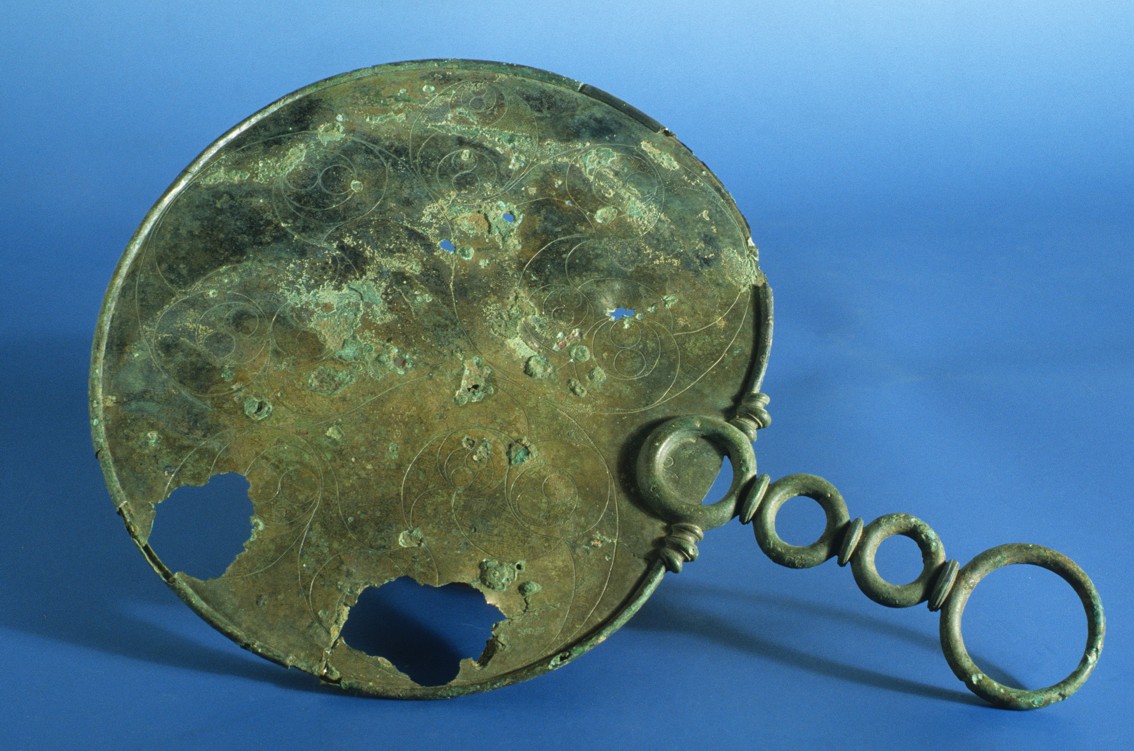
| 15 | Gibbs mirror; British Museum, London, UK | Description: Fragment – Incomplete. Dimensions: Length: 200 mm Diameter: 140 mm (plate) Copper-alloy mirror comprising a sheet metal plate and a cast handle. The plate was originally inscribed with decoration. This is no longer visible but at some point in the past the decoration outline has been traced onto the plate. The plate is damaged at the edges but would originally have been circular. The terminal loop of the handle is missing. The attachment of the handle and plate is secured with two rivets one on each arm of the handle. Background: Kent Acquisition Details: Accession no. 1296.’70. Bequeathed by William Gibbs (1790-1875) of Tyntesfield. Acquisition date 1870. | |
| 16 | Great Chesterford mirror; Cambridge Museum, Cambridge, UK | Description: Broken. Height: 23.5 cm “This Celtic bronze mirror, much like the Old Warden Mirror from Bedfordshire, contains a design based on three-sided voids, rather than lobe patterns. Six matted shapes are located around the perimeter of the mirror. These shapes appear in different form, yet all are connected by the interwoven basket-hatching.” Background: 1st century BC — mid 1st century AD Found circa 1959 in a female burial at Chesterford, Essex, UK. -Source: University of North Carolina at Chapel Hill, unc.edu, 8/17/09 Acquisition Details: ? |
|
| 17 | Holcombe mirror; British Museum, London, UK | Description: Intact – but with pitted surfaces. Dimensions: 33×27 cm Length: 372.000 mm Width: 260.000 mm Weight: 800.000 g “The mirror is made from bronze and is decorated with a symmetrical ‘Celtic’ or La Tene design. The complicated design is now difficult to see because it was badly corroded by being buried for 2000 years at the bottom of a pit. In fact, when the mirror was first found, no one could see any decoration on the mirror plate at all. It was only after it was carefully cleaned by conservators at the British Museum that the design could be made out.” Background: “Iron Age, Bronze, about AD 30 — 70 Found under the Roman villa buildings at Holcombe, towards the South Dorset-Devon border. Excavated by Lady Fox around 1973. In 1967 Devon Archaeological Society heard that a Roman mosaic pavement had been found by a farmer near Uplyme in East Devon. The Society started archaeological excavations at the site in 1969 and discovered a Roman villa. In 1970 a volunteer on the dig, Nicholas Riall, was excavating a pit found under the floor of one of the rooms in the villa. In the bottom of the pit he found an Iron Age bronze mirror, which was placed there during the first century AD.” -Source: British Museum, britishmuseum.org, 8/12/09 Acquisition Details: ? |
|
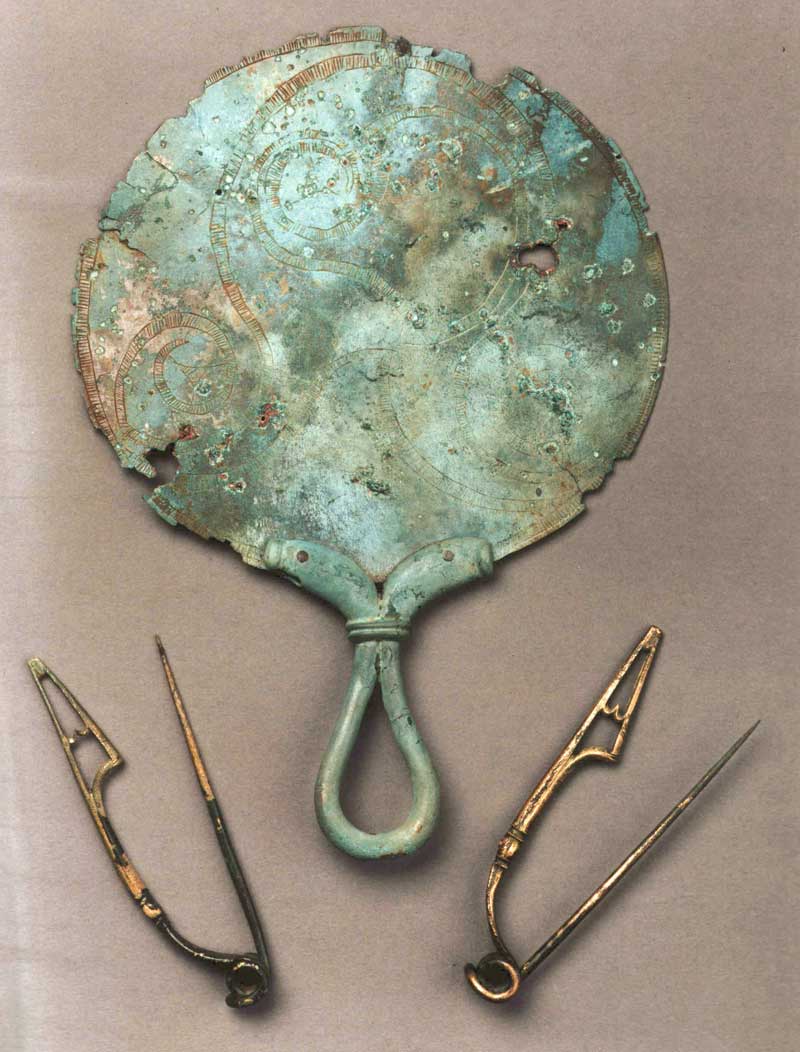
| 18 | Latchmere Green mirror; Andover Museum, Hampshire, UK | Description: The Latchmere Green mirror is currently on display at the Andover Museum. More information about the Latchmere Green mirror can be found in the Proceedings of the Prehistoric Society – Volume 64, 1998, A Late Iron Age Mirror Burial from Latchmere Green, near Silchester, Hampshire By Michael Fulford and John Creighton – Source: David Allen, Hampshire County Council, October 2009. Background: This paper describes the find, in 1994, of an isolated Late Iron Age burial near the oppidum of Calleva Atrebatum (Silchester). The burial consisted of the cremated remains of an adult of about 30 years together with a child of under 5 years, buried in a pottery jar of a type familiar from Calleva. The jar also contained cremated pig bone. The burial was accompanied by fragments of at least two fibulae and a very finely decorated bronze mirror, for which no close parallels are known. The burial dates to the 1st century BC, possibly before 50 BC. – Source: David Allen, Hampshire County Council, October 2009. Acquisition Details: ? | |
| 19 | Llechwedd-du Bach mirror; National Museums & Galleries of Wales, UK | Description: Incomplete. “Bronze circular mirror with a handle of Late Celtic design. The triple loops of the handle, which is of cast bronze, are linked by beaded collars.” -Source: gtj.org.uk, 8/21/09 Background: Merioneth, Wales “Found in the mid-19th century with a tinned bronze plate. Both items may have come originally from a woman’s burial. Roman mirrors served exactly the same purpose of personal vanity as they do today. At least one side of the mirror plate would have been silvered or tinned to achieve a reflective surface.” Acquisition Details: Item reference 25.73/1 This item comes from museumwales.ac.uk. If you would like to see the original item, or require information regarding copyright, please contact the repository/contributor named above. | |
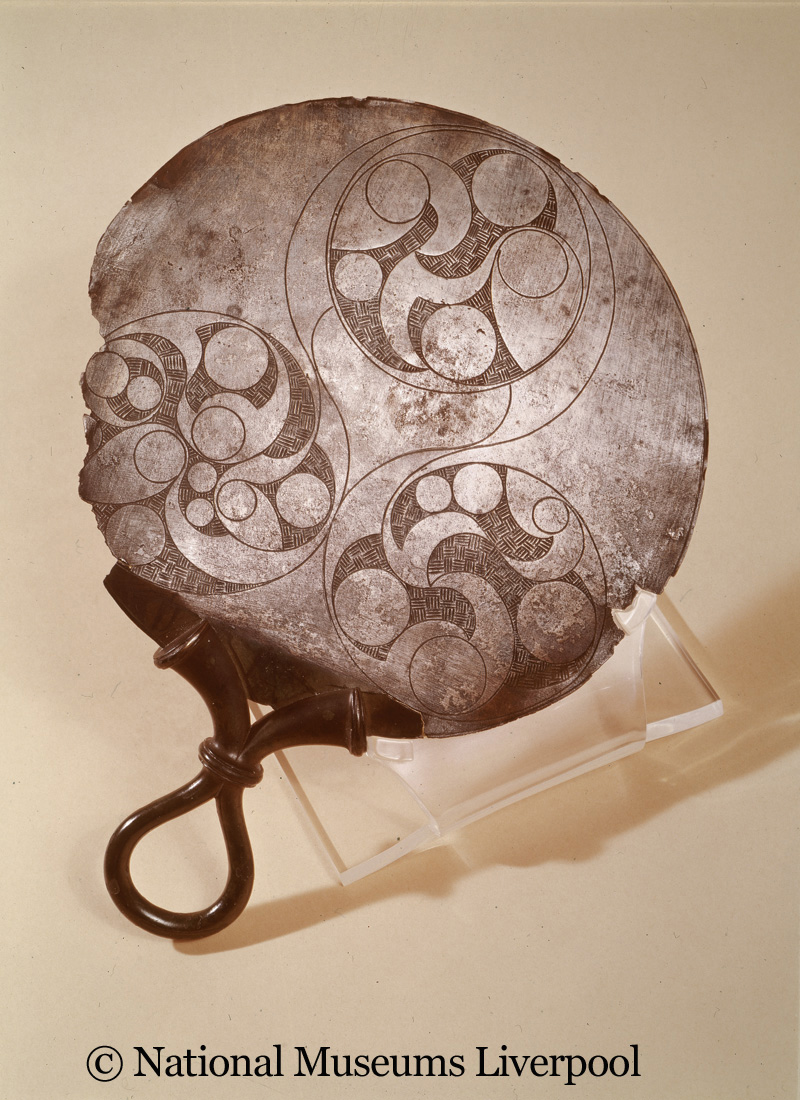
| 20 | Mayer mirror; World Museum, Liverpool, UK | Description: Incomplete – missing outer elements and rim. Bronze. Height: 22.5 cm Also called the Engraved Mirror, Southeast England. City Museum, Liverpool Background: 1st century BC — mid 1st century AD “This flat bronze mirror displays a variety of sub-triangular and curvilinear forms with lobe patterns accenting the design. The decoration consists of three circles, or roundels, in which three-sided voids are carefully situated. The unprovenanced Mayer mirror, possibly one of the earliest, shows a simpler version of the lyre, a design executed with consummately economical craftsmanship (Megaw 30). Even though some damage has affected this mirror, the majority of the mirror has been well preserved, especially considering the age of such an object. The Mayer Mirror has a basic loop handle. A small iron loop is ‘tied’ around the middle of the loop creating a teardrop shape, a shape in which one could easily hang the mirror on the wall.” -Source: University of North Carolina at Chapel Hill, unc.edu, 8/14/09 Acquisition Details: Accession no. M6395, donated to the museum in 1867 by the antiquarian Joseph Mayer, (Dr. Ashley Cooke, 6-15-09). | |
| 21 | Nijmegen mirror; Valkhof Museum, Nijmegen, Netherlands | Description: Incomplete. Diameter: 29.3 cm Background: "Found in a grave of the second century BC, Nijmegen, Netherlands. Nijmegen, a city in the Netherlands, where several Roman settlements have been discovered. Made in England between 50 BCE and 50 CE, this mirror was taken to Germania Inferior by a Batavian soldier serving in Britain, and buried in a second-century tomb in Nijmegen." -Source: Livius.org, livius.org, 8/18/09 Acquisition Details: ? | |
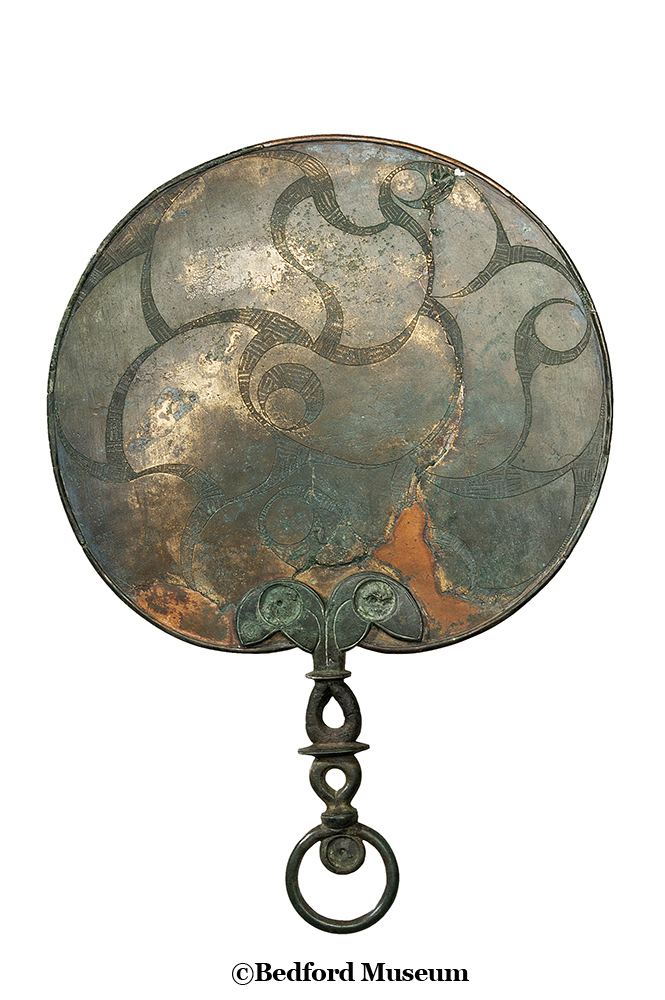
| 22 | Old Warden mirror; Bedford Museum, Bedfordshire, UK | Description: Bronze. Intact. Height: 28.3 cm “Three-sided voids primarily dominate the Old Warden Mirror, much like the Great Chesterford Mirror. Four open roundels are asymmetrically situated throughout the design. Much of Celtic Art is ornamental, thus, it does nothing more than serve an aesthetic purpose. The decoration on the mirrors is simply nonfunctional. -Source: University of North Carolina at Chapel Hill, unc.edu, 8/14/09 Background: 1st century BC — mid 1st century AD “Information you have requested can be found in a paper published by Mansel Spratling in 1970. The paper 'The Late Pre-Roman Iron Age Bronze mirror from Old Warden' was published in the Bedfordshire Archaeological Journal, Volume 5, 1970, pages 9-16, plates 1, 2 and 3. The volume is edited by DH Kennett and is published by The Bedfordshire Archaeological Council.” – Source: Liz Pieksma, Bedford Museum, October, 2009. Acquisition Details: ? | |
| 23 | Oxfordshire mirror, Privately-held, unknown location | Description: Dimensions: Height: 10 3/4 inches Diameter of Disc: 7 1/4 inches Length of handle: 5 inches Width of handle where it inserts onto disc: 2 3/4 inches The Mirror is made of copper-alloy, and consists of two elements – the Disc was found intact and the handle was in two pieces. It is in very good condition and its complex and beautiful decoration is an unusual and innovative example of Celtic ‘mirror-style’ art’. This one is of an early type, dating to the first century BC, and is decorated with a highly unusual and beautiful curvilinear, La Tène style pattern which has been inscribed into the back by a craftsman who must have been extraordinarily skilled. Unlike the Desborough mirror that was probably drawn with a compass, the design on the Oxfordshire mirror may have been drawn freehand and is most similar to the Pegsdon/Shillington Mirror. Background: 75 BC This mirror was discovered by a metal detectorist in the Didcot area circa 2006 in Oxfordshire, U.K., and the finder reported it to St Albans Finds Liaison Officer. Mirrors from southern England, like this specimen are highly significant for our understanding of the later Iron Age, and offer important insights into the social changes which occurred in the century before the Roman conquest in AD 43. They are potentially objects of high status, and their manufacture and usage, alongside toilet implements such as tweezers and grinders for cosmetics, demonstrate the importance of personal appearance as a means of social expression during the later Iron Age. Oxfordshire has many Iron Age sites such as Badbury Rings, Uffington Castle and the newly excavated Great Western Park site in Didcot. Acquisition Details: “The mirror was subsequently taken by the two (of the finders) to St. Albans Museum where it was professionally restored and conserved by archaeologists.” The Oxfordshire Museum commenced a fundraiser to purchase the mirror, and successfully raised 33,000 English pound (about USD 51,500), to purchase the mirror from a private collector, who purchased the mirror from the finder, in 2007. For Relevant Literature please consult: Atlas of The Celts. By Barry Raftery, University College Dublin. ISBN: 0-540-08153-1 – Source: bidancient.com, 8/27/09 | |
| 24 | Portesham mirror; Dorset County Museum, Dorset, UK | Description: Bronze. Intact. Dimensions: 31 x 19 cm “Composed of cast and hammered bronze parts with engraved and chased design on the mirror back. Probably individually composed for the owner and suggests her high social status.” -Source: "The Portesham mirror," artfund.org, 8/18/09 PDF Background: 1st century BC — mid 1st century AD “Excavated at Portesham, Dorset, October 1994.” -Source: "The Portesham mirror," artfund.org, 8/18/09 PDF Acquisition Details: Total cost in 1995 was £75,000, £18,500 of which was provided by a grant from the Art Fund. (A non-government British charity that relies on membership subscriptions and public donations.) Vendor: Robert Fraser and John Rule - Source: "The Portesham mirror," artfund.org, 8/18/09 PDF For more details about the Portesham Mirror, artfund.org, click here, 8/18/09. PDF |
|
| 25 | Rivenhall mirror (fragment); Chelmsford Museum, Chelmsford, UK | Description: Iron Age Fragment with handle. Dimensions: Height: 276 mm Width: 200 mm The Rivenhall mirror is currently on display at the Chelmsford Museum. Background: “1st century BC — mid 1st century AD Found in 1848 near the church ‘beside a passage of Roman pavement’ in Essex.” Acquisition Details: “Accession no. B18303. Donated by the Chelmsford Philosophical Society. For relevant literature please consult: [Citation] Fox, Sir Cyril, ARCHAEOLOGIA. 61:337, Figure 5; Rodwell & Rodwell, Rivenhall Investigations II, CBA. 80: 29-33, Figure 12-3 – Plate 23b.” – Source: Anne Lutyens-Humfrey, Chelmsford Museums, August 2009. | |
| 26 | Shillington mirror; Wardown Park Museum, Luton, UK | Description: Bronze (mirror) & Silver (brooch) Broken. Diameter: 20 cm “A mirror decorated in a swirling early Celtic style using engraved circles, ovals and arches, emphasised by a fine basket weave in fill. The mirror is round with a relatively simple loop handle which is typical of its time. The brooch was found in close proximity to the mirror together with some pottery shards.” Background: 70 — 20 BC Found by metal detectorists at a farm in Shillington, Bedfordshire. -Source: "Shillington mirror & brooch," artfund.org, 8/14/09 PDF Acquisition Details: ArtFunded in: 2002 Vendor: Department for Culture, Media and Sport. Total cost in 2002 was £35,000, £7,000 of which was paid by a grant from the Art Fund. (A non-government British charity that relies on membership subscriptions and public donations.) For more information about the Shillington mirror, click here. PDF | |
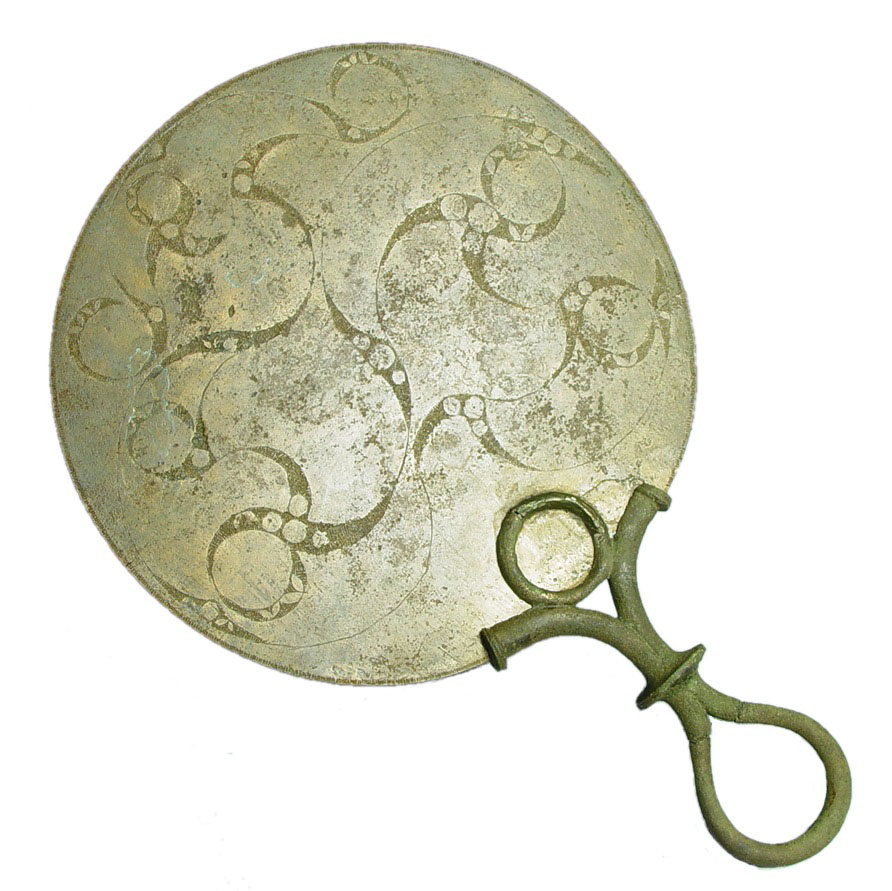
| 27 | Trelan Bahow (aka St. Keverne) mirror; British Museum, London, UK | Description: Incomplete with pitted surfaces. Height: 22 cm Diameter: 16.500 cm “Decorated copper alloy mirror, with engraved La Tène decoratation on back and cast handle. The front of the mirror is much pitted with corrosion. The back is decorated in a relatively simple style arranged within two circular areas. There is a border of hatched triangles. The handle has a loop which is contained within a Y-shape beyond a double moulding.” Background: “Period/Culture: La Tène Iron Age 100 — 1 BC Found in one of several graves in a field called Bahow Trelan farm on southern edge of Goonhilly Down, in 1833. In 1833 a new road was being made across the Trelan estate in western Cornwall when the workmen found a number of Iron Age burials. This mirror was discovered in one of the graves found by the workmen in 1833. There were other objects in the grave including two brooches, two glass beads and two rings or bracelets. No scientific examination was carried out on the skeleton to establish the dead person’s sex and it was assumed that a mirror and jewellery must belong to a woman.” -Source: British Museum, 8/12/09 PDF Acquisition Details: Gift of J.J. Rogers, with the sanction of T.H. Edwards For more information about the Trelan Bahow mirror, click here. PDF |
|
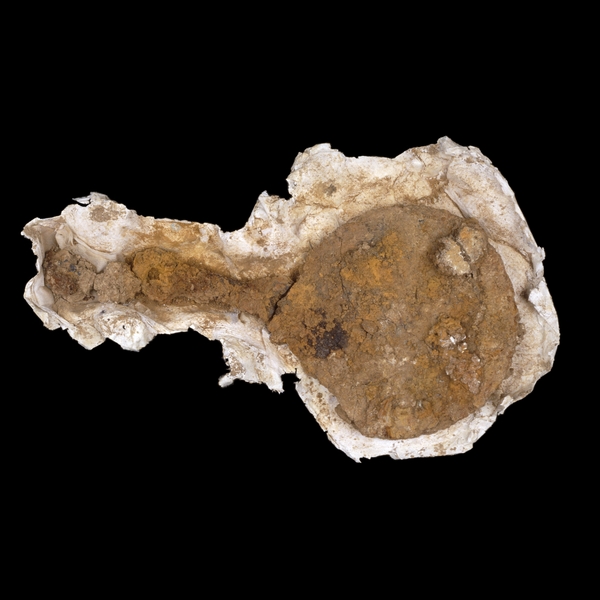
| 28 | Wetwang mirror, British Museum, London, UK | Description: Iron Age circa 300 BC East Yorkshire, England This iron mirror was found resting against the woman’s ankles in the grave. Careful cleaning has revealed well over a hundred tiny blue glass beads, so small that they could only have been threaded on to horse hairs, as well as metal and coral beads. Were the beads from a tassel at the end of the handle, or perhaps from a bag in which the mirror was kept? As the mirror decayed, impressions formed in the rust of some cloth where it touched the mirror. Why was the mirror in the grave? Was it an important personal object that the woman used in life? Did the mirror have a special religious or magical role?. These are questions that we may never be able to fully answer. – Source: British Museum, britishmuseum.org, 10/25/09 Background: “Found in 2001 in a Chariot Grave near Wetwang in East Yorkshire, England by Adrian Havercroft and his team from Guildhouse Consultancy. The body in the grave at Wetwang was that of a woman. What was special was the richness of the woman’s grave, the decoration in red coral of so many items, and her mirror. This was found lying over her lower leg bones; it was made of iron, and upon being safely lifted from the grave, removed to the laboratory for final excavation and conserving. During this process it was discovered that there was also a mass of tiny blue glass beads, only a few millimetres in diameter, together with metal, and possibly coral beads and spacers located next to the handle of the mirror.” -Source: yorkshirehistory.com, 8/14/09 Acquisition Details: ? |